
Huidu HDSign – Free Download, Setup Guide & Compatible Cards
Huidu HDSign is a free LED control software by Huidu Technology, built for single-color and dual-color LED displays. It runs on Windows XP through Windows 10, and connects to your screen via LAN, Wi-Fi, USB flash drive, or serial port.
This guide covers everything — compatible control cards, download, installation, setup, and common troubleshooting. If you’re new to HDSign, start here.
Table of Contents:
1. What Is Huidu HDSign Software?
2. HDSign Compatible Control Cards
3. Free Download HDSign and Getting Started
4. Core Features and Supported Content
5. How Huidu HDSign Works in Real Scenarios
6. Basic Workflow: From Setup to Display
7. Communication Settings: LAN, Wi-Fi, and USB
8. HDSign vs HD2018 vs HD2020
9. FAQ
10. Conclusion
1. What Is Huidu HDSign Software?
HDSign is Huidu’s control software for single-color and dual-color LED screens. You use it to build content programs on your PC, then push them to the screen. Once sent, the screen runs on its own — no computer needs to stay connected.

Who is it for?
HDSign works with single-color and dual-color LED screens — the kind you see in shops, gyms, mosques, and outdoor storefronts. These are typically bar-style displays driven by Huidu’s E-series, W-series, or U-series control cards. That said, if your screen uses a full-color RGB module, HDSign is not the right tool. For full-color screens, Huidu uses HDPlayer or HDSet instead.
How does it work?
The software runs on a three-level structure: screen → program → partition. You start by creating a screen file that matches your physical display. Then you add programs — each one works like a playlist item with its own schedule. Inside each program, you divide the display into up to 20 zones, and each zone shows a different type of content. Once everything looks right in the preview, you send it to the screen over LAN, Wi-Fi, or USB.
That’s the whole workflow. The rest of this guide walks through each part in detail.
2. HDSign Compatible Control Cards
Before you download HDSign, it’s worth checking your control card model first. The card is mounted inside the LED cabinet, and the model number is printed directly on the board. Getting this right saves you a lot of back-and-forth later.
| Card Model | Color Support | Max Resolution | Communication |
| HD-E64 | Single / Dual Color | 2048 × 256 px | LAN, USB |
| HD-E63 | Single / Dual Color | 2048 × 256 px | LAN, USB |
| HD-W66 | Single / Dual Color | 4096 × 256 px | Wi-Fi, LAN, USB, Serial |
| HD-W02 | Single / Dual Color | 1024 × 32 px | Wi-Fi, USB |
| HD-U60 | Single / Dual Color | 1024 × 32 px | USB |
| HD-U6A | Single / Dual Color | 512 × 32 px | USB |
A few things worth knowing about these cards.
The HD-E64 is the most common network card and the one featured throughout the official HDSign manual. If your screen connects to a PC or router via Ethernet, this is likely what you have. The HD-E63 is an older revision with the same basic specs — HDSign handles both the same way.
The HD-W66 and HD-W02 are Wi-Fi cards. They don’t connect to your router. Instead, each card broadcasts its own Wi-Fi hotspot, and your PC connects directly to that. The default Wi-Fi password is 88888888. We cover the full connection process in Section 7.
The HD-U60 and HD-U6A are USB flash drive cards. There’s no wired or wireless connection involved — you export your program to a USB drive and plug it into the card. Simple, but less flexible if you need frequent updates.
If your card model isn’t on this list, that doesn’t necessarily mean HDSign won’t work. Many Huidu single-color and dual-color cards share the same firmware base. Try running HDSign and see if it detects your card in the Screen Settings panel.
3. Free Download HDSign and Getting Started
You can download Huidu HDSign for free—no license, no activation code.
3.1 Where to Download
The safest way to get the latest version of HDSign software and user manual is from the LedInCloud Huidu Resource Download page. It offers:
- Free access to all official Huidu software
- Clean download links—no ads, no fake installers
- Regular updates

3.2 Why Create a LedInCloud Account
If you register LedInCloud, you unlock more than just downloads.
LedInCloud also helps you:
- Compare prices of different LED display models and controllers
- View products photos and specs
This is especially helpful if you’re planning a new LED project or upgrading from older hardware.
3.3 Quick Installation
After downloading HDSign, just double-click the installer and follow the steps.
Once installed, launch it from the desktop shortcut or Start menu.

3.4 System Support
HDSign runs smoothly on:
- Windows 2000, XP, 7, 8, 10
- 32-bit and 64-bit systems
- No internet connection is required for USB/serial port use
- It supports 22 languages, including English, Chinese, Spanish, Arabic, and Russian.
3.5 First-Time Setup Tips
Step 1: Open HDSign and click “New Screen” (password: 168)
Step 2: Choose your control card, set screen width and height
Step 3: Add a program, insert text or images
Step 4: Use the preview button to test, then send to the screen via USB, LAN, or Wi-Fi

4. Core Features and Supported Content
Huidu HDSign includes everything you need to control a basic LED display. Its interface is clean and icon-based, making it easy to find the tools you need—even if you’ve never used LED software before.
Here’s what you can do with it:
- Display text — Add scrolling messages, announcements, or notices with full control over font, size, and effects.
- Show images — Upload logos, ads, or graphics in formats like JPG, PNG, BMP, and GIF.
- Use 3D and animated text — Create eye-catching visual effects with just a few clicks.
- Insert Excel tables — Perfect for showing schedules, price lists, or data charts.
- Show time and countdowns — Add real-time clocks, calendars, or countdown timers.
- Add sensor data — If you connect external sensors, you can display temperature, humidity, and PM2.5 readings.
- Weather and prayer times — Display weather updates or prayer schedules by selecting your city.
All content can be arranged in sections or “zones” on your LED screen. You can have text on one side, a clock on the other, and a logo at the top—all running at the same time.
HDSign also supports multiple languages and is compatible with different Huidu control cards. This makes it a flexible tool for users across different industries and countries.
5. How Huidu HDSign Works in Real Scenarios
At its core, Huidu HDSign works by breaking your LED display content into three levels: the screen, the program, and the content areas. You start by creating a new screen, then add one or more programs, and finally divide each program into zones where different types of content can be shown—text, images, time, or data.
Once your content is ready, you can send it to the LED screen using a method that fits your setup. If the screen is nearby, a USB flash drive is the simplest way. For more advanced setups, HDSign also supports LAN and Wi-Fi connections, making it easy to update content remotely or manage multiple screens from one computer.
In a real-world setting, this process is surprisingly fast. For example, a shop owner can create a promotion banner in a few minutes, load it onto a USB stick, plug it into the control card, and see the message live on the screen. A school admin can use Wi-Fi to update schedules across different classrooms. A factory manager can display temperature or PM2.5 levels in real time using sensors connected to the control card.
Instead of dealing with complicated programming or third-party tools, users work within one clean interface where everything—from layout to timing to display effects—is visual and easy to adjust.

6. Basic Workflow: From Setup to Display
Once HDSign is installed, setting up your LED screen takes just a few steps. The software uses a simple three-level workflow that helps you organize content and send it to the display quickly.
6.1 Create a New Screen File

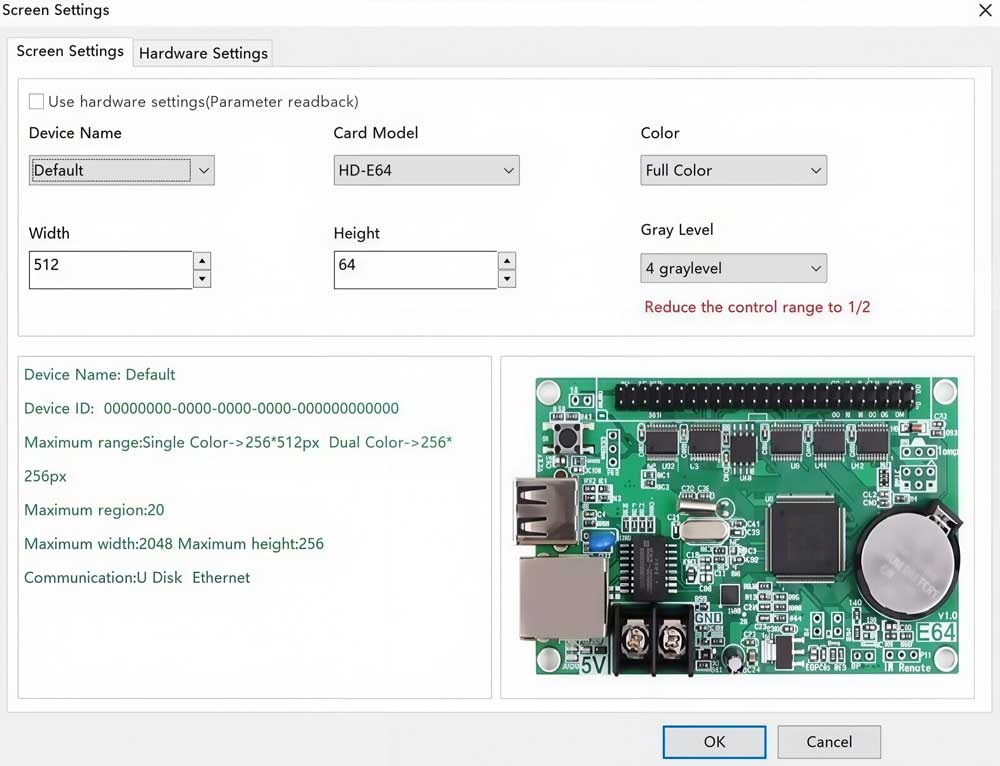
Every project starts with a new screen file. This defines your LED screen’s size, resolution, and color type.
① Go to File > New Display (password: 168)
② Select the control card, set the width and height
③ Choose color type (single or dual color), and grayscale level
6.2 Add a Program
A program is like a playlist. You can create up to 1,000 programs for each screen file, each with its own content and schedule.
① Click the Program icon in the toolbar
② Set playback options (looping, duration, border style)
③ Use different programs for morning, afternoon, or event-specific messages

6.3 Insert Content Areas (Partitions)
Each program can have up to 20 partitions. These are areas where you place text, images, clocks, animations, or data.
① Click icons like Text, Image, Time, Temperature, etc.
② Set position and size freely
③ You can overlay effects, backgrounds, or countdowns

6.4 Preview and Send to Screen
Before sending, you can preview the full layout to see how it looks in real time.
① Click the Preview button to check animations and transitions
② If satisfied, click Send to deliver the content via USB, LAN, or Wi-Fi
③ For USB, remember to check “Export Setting Parameters” the first time
This workflow makes it easy to build professional-looking LED content without writing code or using complex design software. Once you understand this three-step logic—screen → program → partition—everything else becomes intuitive.
7. Communication Settings: LAN, Wi-Fi, and USB
There are three ways to connect HDSign to your LED screen — LAN, Wi-Fi, and USB flash drive. Which one you use depends entirely on your control card model. So before anything else, check the card mounted inside your cabinet.
As a quick reference: E-series cards (HD-E64, HD-E63) use LAN. W-series cards (HD-W66, HD-W02) use Wi-Fi. U-series cards (HD-U60, HD-U6A) use USB.

7.1 LAN (HD-E64 / HD-E63)
LAN is the most reliable option. Just plug a network cable from your PC directly into the control card — HDSign detects the device automatically. No IP configuration, no extra steps.
If the software shows “The selected screen is not bound to a device,” it simply means your screen file isn’t linked to any card yet. Go to Settings → Screen Settings, pick your device from the dropdown, and that’s fixed.
Running more than one card on the same network? Then each card needs its own IP address. Go to Operation → Device Management, assign a unique IP and name to each card, and create a separate screen file for each one in HDSign. After that, use Operation → Multiple Sending to push content to all screens at once — either in multi-screen mode or copy mode.
7.2 Wi-Fi (HD-W66 / HD-W02)
Wi-Fi cards work differently from what most people expect. They don’t connect to your home or office router. Instead, the card itself broadcasts a hotspot, and your PC connects directly to that.
On your PC, open the Wi-Fi list and look for a network named something like W02_xxxxxxxxxx or W66_xxxxxxxxxx. Connect to it — the default password is 88888888. Once connected, HDSign picks up the device automatically.
Note that your PC needs a wireless adapter for this. Laptops have one built in. Desktop PCs usually don’t, so you may need a USB Wi-Fi dongle.
Want to change the default hotspot name or password? Go to Operation → Device Management → Wi-Fi Setting. The new password must be 8 to 16 characters, using letters and numbers.
7.3 USB Flash Drive (HD-U60 / HD-U6A)
USB is the simplest method — no cables, no wireless setup. You build your program in HDSign, export it to a USB drive, then plug the drive into the card. The screen updates on its own.
When you export, there are a couple of options to watch:
- Export the parameters — only check this the first time you configure a new screen. For regular content updates, skip it.
- Adjust Time — check this if your program includes a clock or time display. Without it, the screen time will be wrong.
One limitation worth knowing: USB cards can’t run Smart Settings through HDSign. If your screen isn’t displaying correctly, you’ll need a LAN or serial connection to sort out the hardware configuration first, then switch back to USB for day-to-day updates.
8. HDSign vs HD2020 vs HD2018
If you’ve spent any time looking for Huidu software, you’ve probably seen all three sotwares — HDSign, HD2020, and HD2018. They all handle single-color and dual-color LED screens, so it’s easy to get confused about which one to download.
The short answer: if you’re setting up a new screen today, download HDSign.
But if you want to understand why, here’s the full breakdown.
| Features | HDSign | HD2020 | HD2018 |
| 3D text effects | ✓ | ✗ | Partial |
| Cluster sending | ✓ Full multi-screen + copy mode | Basic | Basic |
| Hardware integration | Deep — covers more card models, wider control range | Moderate | Standard |
| Communication | LAN, Wi-Fi, USB, Serial (232/485) | LAN, Wi-Fi, USB, Serial (232/485) | LAN, Wi-Fi, USB, Serial (232/485) |
| Interface languages | 22 | 23 | Standard Windows |
| OS support | Win XP / 7 / 8 / 10 | Win XP / 7 / 8 / 10 | Standard Windows |
HDSign is the current standard. Huidu built it specifically for modern bar-style screens — the taller, longer formats that are common today. It also consolidates several older controllers under one roof, so you don’t need to hunt for a different software version depending on your card model. On top of that, it adds 3D text effects and a proper cluster sending function for anyone managing multiple screens at once.
9. FAQs
What is the default Wi-Fi password for HDSign?
The default password is 88888888. This applies to all Huidu Wi-Fi control cards, including the HD-W02 and HD-W66. Your PC connects to the card's hotspot using this password. If it has been changed and you do not know the new password, you can reset it in Operation → Device Management → Wi-Fi Setting.
What is the password to create a new screen in HDSign?
When you click File → New Screen for the first time, HDSign asks for a password. The default password is 168.
Which Windows versions does HDSign support?
HDSign officially supports Windows XP, Windows 7, Windows 8, and Windows 10.
My screen isn't showing anything after I send the program. What should I check?
Start with the basics. First, make sure your screen file is bound to the correct device. Go to Settings → Screen Settings and verify that a device name is selected. If no device appears, check your cable or Wi-Fi connection. For a brand-new screen that has never been configured, run Smart Settings under Hardware Settings before sending content.
How many programs can one screen file hold?
Each screen file supports up to 1,000 programs. Each program can contain up to 20 zones, and every zone can display a different content type, including text, images, clocks, countdowns, and more.
Can HDSign control multiple LED screens at once?
Yes. Create a separate screen file for each display, bind each file to its corresponding control card, and use Operation → Multiple Sending to publish content to all screens simultaneously. You can choose multi-screen mode for different content on each display or copy mode for identical content across all screens.
Does HDSign work with full-color LED screens?
No. HDSign is designed for single-color and dual-color LED displays only. For full-color LED screens, use HDPlayer or HDSet instead.
10. Conclusion
Huidu HDSign is a lightweight yet capable software solution for managing single and dual-color LED displays. It keeps things simple—no bloated features, no confusing setup—just the tools you need to create and send clear, dynamic content. Whether you’re using it in a store, factory, school, or public space, HDSign delivers dependable performance with minimal effort. And with free downloads and helpful tools available on LedInCloud – a leading LED Screen Cloud Platform, getting started has never been easier.