
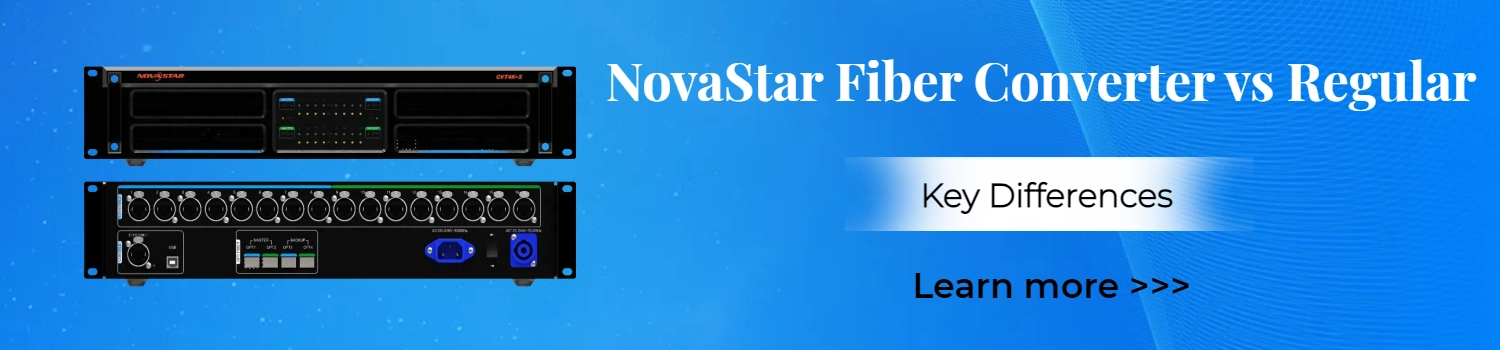
NovaStar Fiber Converter vs Regular: CVT Series Compared
If your LED screen sits far from the control room, a fiber converter is part of the job. It carries your video signal over fiber optic cable without the lag, flicker, or dropouts you get when a copper Ethernet line is pushed past its limit.
But not every fiber converter is right for this job. Many are built for office networks. A NovaStar fiber converter is built for LED control systems—it treats your video signal as the priority, not just another data stream.
In this guide, we go through every model in the NovaStar CVT series. You’ll see what each one does, how the specs compare, and which model fits your screen. LedInCloud – LED Screen Cloud Platform will provide you with the most comprehensive information.
1. What Is a Fiber Converter?
A fiber converter changes electrical signals into light, and light back into electrical signals. That’s the whole job. Your sending card puts out an Ethernet signal. The converter turns it into light, the light travels down a fiber optic cable, and a second converter turns it back into an Ethernet signal at the screen.
Why bother? Because copper has a hard limit. Ethernet cable starts to lose speed and stability after 100 meters, and past that point it often fails completely. Fiber doesn’t have that problem. Depending on the hardware, the same signal can travel 300 meters or 20 kilometers.
That distance is what matters for LED screens. The control room and the screen rarely sit next to each other. They sit on opposite sides of a stadium, or a few floors apart in an office tower. Fiber bridges that gap without signal loss.
In a typical setup, one converter connects to your sending card or video controller. The other sits near the receiving cards behind the screen. The fiber cable runs between them.

You'll work with two fiber types:
– Single-mode fiber: Long range. In the CVT series, single-mode models reach 10 to 20 km. Used for outdoor screens and large venues.
– Multi-mode fiber: Short range. CVT multi-mode models cover 300 to 550 m. Used indoors.
The two types are not interchangeable—they need matching hardware at both ends. That’s one reason LED control brands like NovaStar build their own converters instead of leaving you to piece together generic network gear.
2. Core Differences: NovaStar Fiber Converter vs Regular One
On paper, a fiber converter is a simple box: signal in, light out, light in, signal out. So why pay more for a NovaStar unit? The difference shows up in what happens when real video runs through it—especially 4K content at high refresh rates, in places that are loud, hot, or far away.

2.1 Quick Comparison
| Feature | Novastar Fiber Converter | Regular Fiber Converter |
| Designed for LED Displays | ✅ Yes, optimized for video signals | ❌ No, made for general data transfer |
| Transmission Distance | Up to 20km (CVT320, single-mode) | Usually under 2km |
| Compatibility | Seamless with Nova sending cards & systems | May have signal or sync issues |
| Signal Stability | High-designed for real-time video | Medium-may drop under pressure |
| Anti-Interference | Strong-built for noisy environments | Limited resistance |
| Supports 4K Video | ✅ Yes (e.g. CVT4K-S, CVT4K-M) | ❌ Rarely supports high-bandwidth video |
| Setup & Integration | Plug-and-play with Nova hardware | May require adjustments |
| Support & Documentation | Complete specs, firmware support | Often minimal |
2.2 Built for LED Displays
Generic converters move data packets. Nobody notices a 40-millisecond delay in a file transfer. On an LED wall, everyone notices. A converter that isn’t tuned for live video can cause flicker, frame tearing, or color shifts—small faults that ruin the picture even though the signal technically “arrives.”
NovaStar converters are built around LED control systems. The result is smoother frame sync and consistent color across long runs, which is exactly what a video wall needs.
2.3 Stable Over Long Distances
The CVT320 pushes a signal 20 kilometers over single-mode fiber. That’s not a marketing number—it’s what makes remote installations possible. A highway sign 15 km from the control cabinet. A campus screen linked across buildings. Generic converters typically top out near 2 km, and video quality degrades well before that.
2.4 Designed to Work with NovaStar Systems
NovaStar converters plug straight into NovaPro UHD, the H series, and MCTRL processors. No drivers, no configuration, no guessing. Mix in a generic converter and you may still get picture—but users report dropped signals and frame lag when brands get mixed. On a live event, that’s a risk you don’t want to carry.
2.5 Better Handling of Interference
LED screens don’t run in clean labs. They run next to power lines, lighting rigs, radio gear, and miles of cable. Fiber itself resists electromagnetic interference, but the converters at both ends still need proper shielding and build quality. NovaStar designs for those environments—outdoor billboards, stadiums, concert stages—where a cheap converter would show its limits.
2.6 Real Support, Real Specs
Generic converters usually come with a one-line spec and no firmware path. NovaStar publishes full datasheets, SFP module details, and firmware updates for every CVT model. When you’re specifying hardware for a project that must run for years, that documentation is worth as much as the hardware.
3. NovaStar CVT Series Models Comparison
NovaStar CVT is the model series name of NovaStar fiber converters. “CVT” covers every fiber converter NovaStar makes for LED display systems—the CVT310, CVT320, CVT10, CVT10 Pro, and CVT4K lines. Each model converts the electrical signal from your sending card into light, sends it over fiber, and converts it back near the screen.
The suffix tells you the fiber type: S is single-mode, M is multi-mode. But check the distance before you buy—same suffix, different reach. The CVT320 runs 20 km over single-mode fiber, while the CVT10-S, CVT10 Pro-S, and CVT4K-S all stop at 10 km. On the multi-mode side, the CVT310 goes 550 m while the CVT10-M, CVT10 Pro-M, and CVT4K-M are rated for 300 m.
3.1 The CVT310: Compact Multi-Mode for Short Indoor Runs
The CVT310 is the series entry point. One Gigabit Ethernet port, one multi-mode LC optical port, up to 550 m. It draws 3.5 W, weighs 0.53 kg, and costs less than any other model in the lineup. If your indoor screen sits within 550 m of the control room and you don’t need extra ports, this is the one to buy.

3.2 The CVT320: The Long-Distance Specialist
The NovaStar CVT320 swaps the multi-mode port for a single-mode one and holds the same compact body. Its 20 km reach is the longest in the CVT lineup—built for highway signs, airport links, and campus runs where the control room sits kilometers away. One port in, one port out. Simple, effective, and with no backup link, so it’s best when the fiber path is protected.

3.3 The CVT10: Ten Ports and Fiber Backup in Half a Rack
The NovaStar CVT10 fiber converter jumps to 10 Gigabit Ethernet ports and dual optical ports—OPT1 works as the primary link and OPT2 stands by as backup. Two units combine into a single 1U rack assembly, which is why touring racks love it. Single-mode versions reach 10 km; multi-mode versions cover 300 m.

3.4 The CVT10 Pro: The Touring-Grade Version
The CVT10 Pro keeps the CVT10 port layout and rebuilds everything around it for the road: dustproof and waterproof design, truss-mount capability with φ10mm bolts, and a full-width chassis that handles stage abuse. If your screen travels to outdoor stages and festival grounds, this is the model built to survive the trip. Many rental houses ask for the CVT10 Novastar when they spec a touring build—it has become the default choice in that world.

3.5 The CVT4K: Sixteen Ports for Fixed Control Rooms
The NovaStar CVT4K-S and CVT4K-M are the flagship models for permanent installs. You get 16 Neutrik Ethernet ports, four optical ports (OPT3 and OPT4 back up OPT1 and OPT2), and dual redundant power supplies. Stadium control rooms and broadcast racks that run 24/7 are the natural home for this line. Single-mode reaches 10 km; multi-mode covers 300 m.
The NovaStar CVT4K-S fiber converter is the single-mode version, and it’s the one most fixed installations pick. Its 10 km reach covers the distance from a remote control hub to the main screen, and the four optical ports leave room to grow.


3.6 Comparison Table
| Model | NovaStar CVT4K-S | NovaStar CVT4K-M | NovaStar CVT320 | NovaStar CVT310 | NovaStar CVT10-S/M | NovaStar CVT10 Pro-S/M |
| Fiber Type | Single-mode | Multi-mode | Single-mode | Multi-mode | Single-mode (S) / Multi-mode (M) | Single-mode (S) / Multi-mode (M) |
| Optical Ports | 4× LC (Twin-core) | 4× LC (Twin-core) | 1× LC (Twin-core) | 1× LC (Twin-core) | 2× LC (Twin-core) | 2× LC (Twin-core) |
| Ethernet Ports | 16× Neutrik | 16× Neutrik | 1× Gigabit | 1× Gigabit | 10× Gigabit | 10× Gigabit |
| Wavelength | 1310 nm | 850 nm | 1310 nm | 850 nm | 1310 nm (S) / 850 nm (M) | 1310 nm (S) / 850 nm (M) |
| Max Distance | 10 km | 300 m | 20 km | 550 m | 10 km (S) / 300 m (M) | 10 km (S) / 300 m (M) |
| Data Rate | 9.95-11.3 Gb/s | 9.95-11.3 Gb/s | 1.25 Gb/s | 1.25 Gb/s | 9.95-11.3 Gb/s | 9.95-11.3 Gb/s |
| Power (Rated) | 21 W | 21 W | 3.5 W | 3.5 W | 18 W | 22 W |
| Operating Temp | –20°C to +60°C | –20°C to +60°C | –20°C to +70°C | –20°C to +70°C | –20°C to +55°C | –20°C to +55°C |
| Dimensions (mm) | 482.6×377.0×96.0 | 482.6×377.0×96.0 | 149.0×135.0×38.0 | 149.0×135.0×38.0 | 254.3×50.6×290.0 | 482.6×88.1×280.0 |
| Redundancy | Dual power, OPT3/4 backup | Dual power, OPT3/4 backup | — | — | OPT2 backup port | OPT2 backup port |
| Key Features | Dual control ports | Dual control ports | Compact design | Compact design | Modular rack-mount | Dust/waterproof, truss-mountable |
Note: On CVT4K models, the OPT-to-Ethernet port mapping depends on your sending card’s encoding. Older-encoding cards map OPT1 to ports 1–8 and OPT2 to ports 9–16. Newer-encoding cards map OPT1 to ports 1–10 and OPT2 to ports 11–16. OPT3 and OPT4 stay as backups either way. Confirm the pairing with LedInCloud team.
3.7 Recommended Use Cases
| Model | Best For |
| CVT4K-S/M | Stadiums, control rooms requiring high bandwidth and redundancy. |
| CVT10 Pro-S/M | Outdoor events, harsh environments (e.g., concerts, construction sites). |
| CVT10-S/M | Touring events, space-constrained racks. |
| CVT320 | Long-distance single-link transmission (e.g., highway signs). |
| CVT310 | Indoor LED screen with ≤550 m fiber runs. |
4. Where NovaStar Fiber Converters Work Best?
Every CVT model has a natural habitat. Here’s where each one earns its keep.

4.1 Large Fixed Installations
Stadiums, broadcast studios, and 24/7 control rooms need the CVT4K-S/M. Sixteen Neutrik ports distribute signal across massive LED walls, four optical ports (with OPT3/OPT4 backup) keep the fiber path redundant, and dual power supplies remove the single-point-of-failure problem. The single-mode CVT4K-S links screens up to 10 km from the control hub. This is the model you install once and forget.
4.2 Mobile & Temporary Events
Touring concerts, exhibitions, and festivals put hardware through a different kind of stress. The CVT10 Pro-S/M is built for it: dustproof and waterproof, mountable on truss with φ10mm bolts, and rated for the bumps of load-in and load-out. The standard CVT10-S/M covers the same job on a budget—two units form a 1U rack assembly, so space-constrained touring racks stay compact. Multi-mode versions handle the short runs between stage and amp city (≤300 m).
4.3 Long-Distance Infrastructure
Highway signs, airport displays, and industrial campuses share one problem: the screen is far from the controller. The CVT320 solves the extreme case with 20 km over single-mode fiber. The CVT310 covers mid-range indoor runs up to 550 m at the lowest cost. Both share the same small body (149 × 135 × 38 mm), so they fit roadside cabinets and tight electrical enclosures.
4.4 Challenging Environments
Construction sites, coastal installs, and mining operations combine dust, moisture, and temperature swings. The CVT10 Pro handles them with its dustproof and waterproof design, rated from –20°C to +55°C.
5. FAQs About NovaStar Fiber Converters
Q1. How do I choose between CVT4K and CVT10 Pro for large events?
Look at where the box will live. Fixed control rooms take the CVT4K—16 ports and OPT3/OPT4 backup suit high-density, always-on setups. Outdoor stages take the CVT10 Pro: dustproof, waterproof, and truss-mountable. If your event moves, the Pro wins. If your rack never leaves the room, the CVT4K wins.
Q2. Can I mix single-mode and multi-mode converters in one setup?
No. Single-mode runs at 1310 nm, multi-mode at 850 nm—the pair must match end to end. Use the CVT320 or CVT4K-S for single-mode, the CVT310 or CVT10 Pro-M for multi-mode. Mismatched pairs won't link.
Q3. Do NovaStar converters support daisy-chaining?
No. What they offer instead is optical backup: the CVT10 and CVT10 Pro use OPT2 as the backup for OPT1, and the CVT4K series uses OPT3/OPT4 for OPT1/OPT2. Ethernet and USB ports are not for cascading—they connect to the control computer only.
Q4. Why is my CVT310's transmission unstable beyond 300m?
The CVT310 is rated to 550 m, but real-world performance depends on the fiber plant. Check three things: fiber grade (OM3 or OM4), bend radius (≥10× cable diameter), and connector cleanliness. If the run exceeds 550 m, move to single-mode—the CVT320 covers 20 km.
6. Conclusion
A generic converter can work—for a short indoor run, a static image, a budget build. But LED screens rarely live in ideal conditions. They hang in stadiums, run on city billboards, and tour with live shows. Those jobs ask for distance, bandwidth, and stability that generic hardware can’t guarantee. That’s where a NovaStar fiber converter earns its place.
The CVT series covers every job on that list. The CVT320 covers 20 km. The CVT10 and CVT10 Pro bring port density and fiber backup to mobile racks. The CVT4K anchors fixed control rooms with 16 ports and dual redundancy. Match the model to the job, and the transmission chain stops being the part you worry about.
Not sure which one fits? Contact LedInCloud — we’ll help you match the converter to your screen.