
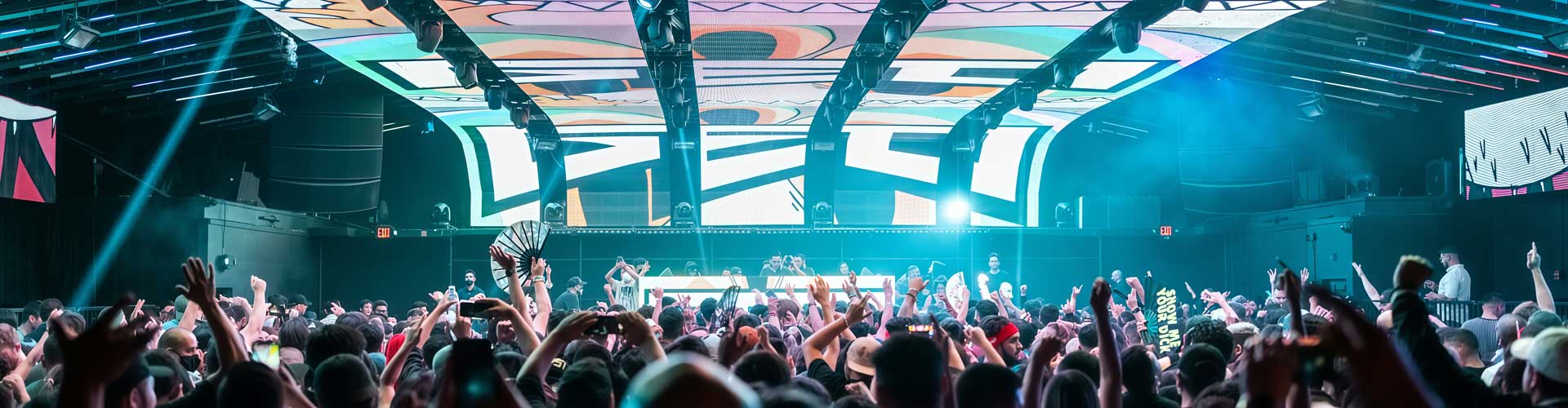
DJ LED Screen
Built for the Stage, Made to Move
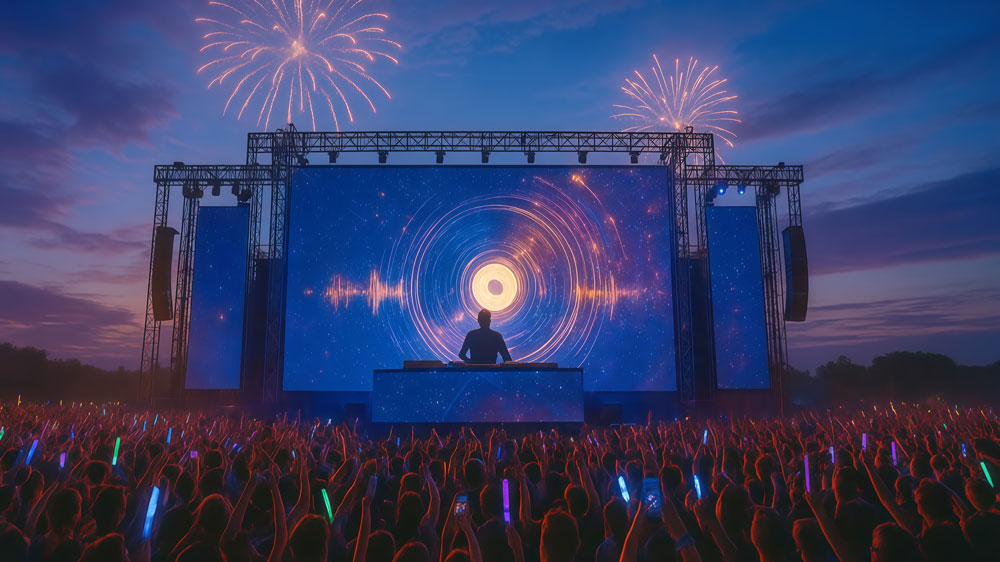
Today’s audiences don’t just listen — they feel the music through visuals.
At every major festival or club, the LED screen has become the centerpiece of the stage, blending sound, light, and motion into one immersive experience. It transforms rhythm into light, and performance into emotion.
- Club & Bar DJ
- Touring & Festival DJ
- Event Planner
- Stage Designer
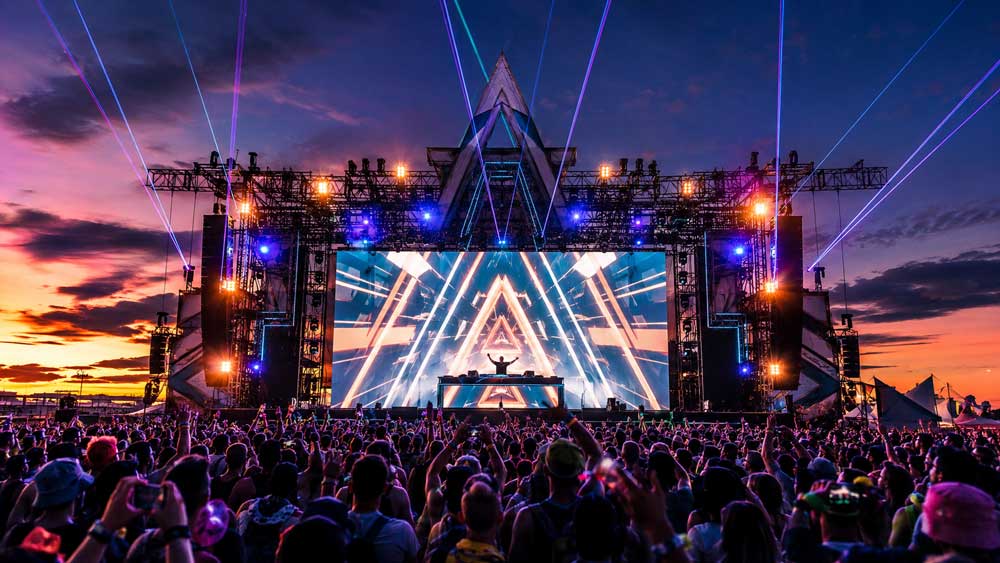
Recommended DJ LED Screen Solutions
Every performance space is unique — from compact club booths to large-scale festival stages.
LedInCloud provides a complete line of DJ LED screen solutions designed to meet diverse installation, mobility, and visual requirements.
Best for: Festival DJs and custom DJ booth builds
Playing an outdoor festival? The MX is IP65-rated front and back, so a surprise rainstorm won’t shut down your set. The cabinet curves from -10° to +10°, which means you can build a tunnel, a U-frame, or a full wraparound booth display — not just a flat wall. No fan noise either, so it won’t compete with your monitors in tight club spaces.
- Pixel pitch: P2.604 / P2.976 / P3.91
- IP rating: IP65 (front & rear)
- Curve range: -10° to +10°
Best for: DJs who play different venues every week
At 6kg per cabinet, it loads in and out without killing your crew. Front panels come off magnetically in under 5 seconds — no tools, no hunting for screws during a fast turnaround. Playing the same venue for a residency? You can curve 60 cabinets into a full circle for a more immersive stage look.
- Cabinet weight: 6kg (500×500mm) / 11kg (500×1000mm)
- Pixel pitch: P2.604 / P2.976 / P3.91 / P4.81
- Curve range: -6° to +6° (optional lock)
Best for: Resident club DJs and live-streamed performances
Close-up crowd, cameras pointed at your screen, live stream going out — this is where the MS earns its place. Refresh rate up to 7680Hz means zero flicker in broadcast footage. Pixel pitch starts at P1.953, so visuals stay sharp even when your audience is standing a few meters away. Front and rear maintenance access keeps downtime short during multi-night residencies.
- Pixel pitch: P1.953 / P2.604 / P2.976 / P3.91
- Refresh rate: 3,840Hz – 7,680Hz
- IP rating: IP65
LED Display Price Calculator
Just fill the sizes, and get your LED screen budget right now !
Why DJ LED Screens Stand Out?
DJ LED screens are built for live performance, and that’s what makes them different from regular displays.
High Brightness & Visibility
Even under club lights or bright outdoor stages, visuals remain sharp and vivid. Your audience sees every detail, whether it’s a looping visual, logo, or live feed.
Customizable Pixel Pitch
From ultra-close indoor booths to large outdoor stages, DJs can choose the right resolution for the perfect viewing experience.
Flexible Sizes & Shapes
Panels can be arranged to fit booths, backdrops, or entire stage walls. Some DJs even use curved or tunnel setups to create immersive visuals.
Fast Setup & Portability
Designed with touring DJs in mind, LED panels are lightweight, easy to lock together, and come in flight cases for safe transport.
Real-Time Visual Control
Most DJ LED screens can sync with VJ software or DJ controllers, letting you mix visuals as fluidly as your music.
Durability
Built to withstand constant assembly, disassembly, and live event conditions, from smoky clubs to outdoor festivals.
What DJ LED Screen Do You Actually Need?
The right spec depends on your venue, not your budget. Match your setup to the table below — it covers the most common DJ and event configurations.
| Venue Type | Pixel Pitch | Screen Size | Brightness | Recommended Series |
|---|---|---|---|---|
| Club booth (indoor) | P2.604 – P3.91 | 3×2m – 4×3m | 1,500 – 2,000 nits | MS Series |
| Bar / lounge (indoor) | P1.953 – P2.604 | 2×1.5m – 3×2m | 800 – 1,500 nits | MS Series |
| Touring setup | P2.976 – P3.91 | Modular | 2,000 – 3,000 nits | MY Series |
| Outdoor festival (mid-size) | P2.976 – P3.91 | 5×3m – 8×5m | 4,500 – 5,000 nits | MX Series |
| Large outdoor stage | P3.91 – P4.81 | 10×6m + | 5,000+ nits | MX Series |
| Custom booth shape | P2.604 – P3.91 | Custom | Varies | MX / MY Series |
Buying vs. Renting a DJ LED Screen
As a rule of thumb, buying becomes more cost-effective after 15+ events per year, while renting offers greater flexibility for one-off events and temporary setups.
Rent if:
✔ One-off or occasional events
✔ You want flexibility to scale up or down
✔ Storage and logistics aren’t practical for you
Buy if:
✔ 15+ shows per year on the same configuration
✔ You need a custom shape or fixed residency look
✔ Long-term cost matters more than upfront investment
Why Choose LedInCloud DJ LED Display?
LedInCloud’s DJ LED panels are engineered with the stage in mind — every component serves both artistic expression and operational reliability.
Ultra-Slim Stage Build
Crafted from high-strength aluminum alloy, each cabinet is both durable and easy to handle. The reduced weight simplifies transport and rigging, making it ideal for touring events or rapid venue changeovers.
Quick-Lock Assembly
Integrated locks and alignment pins allow a single technician to assemble or disassemble panels within minutes. This design dramatically shortens setup time while maintaining a perfectly seamless visual surface.
Smart Color Match
Each LED module is factory-calibrated and supports on-site fine tuning, ensuring color consistency across every panel — even after multiple installations. The result is a smooth, unified image that enhances the visual atmosphere without distraction.
Low-Latency Signal
Our advanced control systems minimize delay between audio and video output. Visuals respond instantly to rhythm changes, guaranteeing that light and sound stay perfectly synchronized throughout the performance.
Creative Setup Flex
From curved walls to 360° DJ booths and LED dance floors, the modular design supports endless layout possibilities. Panels can be combined in different shapes or orientations to match unique stage concepts and architectural limits.
Stable Power Flow
Dual-supply power redundancy and optimized heat dissipation keep the system stable during long, high-energy shows. Even under intense lighting and high temperatures, the display maintains consistent brightness and performance.
Send Us Message
If you have any LED display projects or technical problems regarding our LED display products. Please send us a message, we will reply to you in 24 hours.
ATTENTION: lf you bought LED Display & LED Module from other suppliers, Please get help from them directly.
DJ LED Screen: Complete Setup and Buying Guide
A DJ LED screen is a modular video display system built for live performances — used in club booths, festival stages, and touring setups around the world. Unlike a regular display, it’s designed to handle the demands of live events: high brightness, fast refresh rates, and a structure that packs down and rebuilds on a new stage every night.
But choosing the right one isn’t simple. Pixel pitch, screen size, indoor versus outdoor brightness, software compatibility — each decision affects what you end up with on stage. Get one wrong and you’re either overspending on resolution your audience can’t see, or running an outdoor screen that washes out in daylight.
This guide covers everything. From what separates a DJ LED wall from a regular display, to connecting your screen to software, to knowing what a 4×3m P3.91 setup actually costs in 2026.
1. DJ LED Screen vs. Regular Display
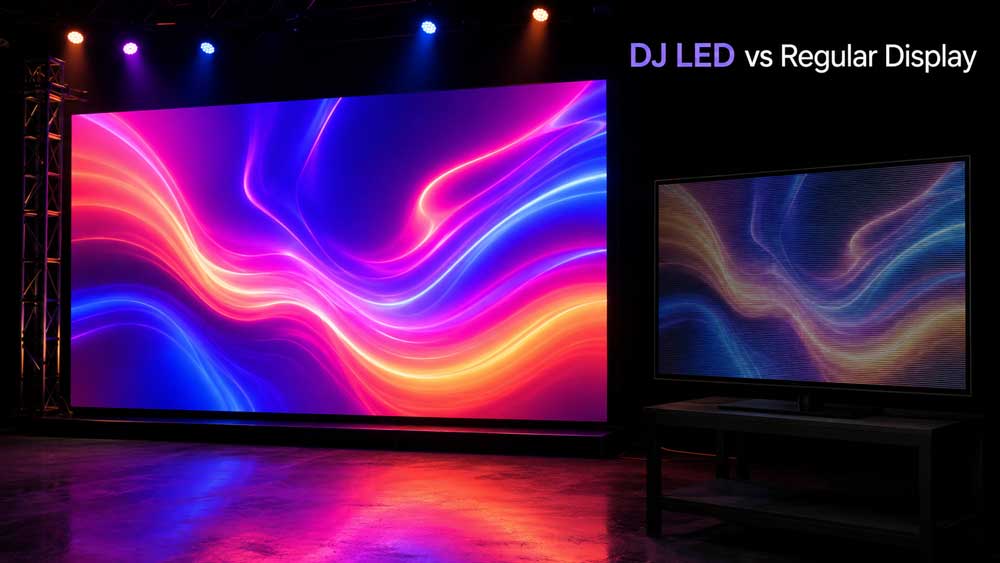
DJ LED screens differ from regular displays in four key ways: refresh rate, modular structure, brightness, and signal handling. Understanding these differences helps you see why a regular TV or monitor won’t cut it on a live stage.
1.1 Refresh rate
DJ LED screens run at 3,840Hz or higher — far above the 60Hz of a standard commercial display. That gap matters the moment a camera enters the picture. At 60Hz, cameras pick up flicker and scan lines in the footage. At 3,840Hz and above, the image stays clean whether you’re recording, live streaming, or just running a big screen behind the booth.
1.2 Modular structure
DJ LED screens are modular, meaning panels lock together on stage and pull apart without tools after the show. A regular display is one fixed unit — you can’t break it down and rebuild it on a different stage next weekend. That modularity is what makes a DJ LED video wall practical for touring. Panels pack into standard flight cases and reassemble in under an hour.
1.3 Brightness
DJ LED screens are significantly brighter than regular displays. Indoor models start at around 1,500 nits. Outdoor LED screens for DJ events go above 4,500 nits — enough to stay visible under direct sunlight and stage wash lighting. A standard TV outputs 300–500 nits. On a festival stage, that disappears.
1.4 Signal handling
DJ LED screens work with video processors and sending cards that handle multiple inputs, real-time switching, and direct sync with VJ software. A regular TV takes one HDMI input and shows one source. That’s the difference between a consumer product and production equipment.
So no — a regular display isn’t a cheaper alternative. It’s simply built for a different job.
2. Common DJ LED Screen Setups
DJ LED screens come in two main shapes — flat and curved — and can be installed by ground stacking or hanging.
2.1 Shape
(1) Flat
A flat DJ LED wall is the most common configuration. Panels align in a straight line to form a rectangular backdrop behind the booth or stage. It works for any venue size, and most LED screen DJ booth installations use this format. If you’re setting up for the first time, flat is the practical starting point.
(2) Curved
A curved DJ LED screen uses panels angled inward or outward to wrap around the booth. This makes the DJ booth itself part of the visual experience rather than just a surface behind it. Most rental-grade cabinets support curve adjustments between -6° and +10° per panel. The more panels you use, the tighter the curve you can achieve.

2.2 Installation Method
(1) Ground stacking
Ground stacking means panels are stacked directly on the floor, usually on a base frame or support structure. This is the go-to method for club booths and smaller indoor events. It’s fast to set up, doesn’t require rigging, and works well for LED video wall DJ booth setups where the screen sits right behind the equipment.
(2) Hanging / Flying
Hanging setups suspend the screen from a truss system above the stage. This method works best for festival stages and larger venues where the screen needs to be visible from a distance. It requires proper rigging hardware and load calculations, but it frees up floor space and gives the stage a cleaner look.
(3) Floor installation
A floor LED screen lays flat on the stage or dance floor, turning the surface itself into a display. Visuals, patterns, and reactive animations play underfoot — synced to the music and lighting. This installation method has different hardware requirements. Panels need to handle foot traffic, so load-bearing capacity and slip resistance are non-negotiable. Not every LED cabinet is rated for floor use. LedInCloud’s FL Series LED Floor Screen is built specifically for this application.
3. Pixel Pitch and Screen Size
Pixel pitch determines image sharpness at a given viewing distance. Screen size depends on your venue dimensions and how far your audience stands from the display. Get them right and the visuals are sharp and impactful. Get them wrong and you’re either wasting money on resolution nobody can see, or scaling up a screen that looks pixelated from the front row.
3.1 Pixel Pitch
Pixel pitch is the distance in millimeters between the centers of two adjacent LEDs. A smaller number means higher resolution — and a higher price. For LED screens for DJ use, the most common options range from P1.953 to P4.81.
The simplest way to choose: divide your viewing distance in meters by 1,000. That gives you the maximum pixel pitch that still looks sharp to your audience.
Viewing Distance | Max Pixel Pitch |
2 – 3m | P2.6 or finer |
3 – 5m | P3.91 or finer |
5 – 8m | P4.81 or finer |
8m + | P5 or coarser |
So if your club audience stands about 4m from the booth, P3.91 is the sweet spot. Going finer than that adds cost without adding anything your audience can actually see.
3.2 Screen Size
Screen size depends on your venue dimensions and how far your audience sits from the screen. A DJ LED wall that’s too small disappears in a large room. One that’s too large overwhelms a tight space.
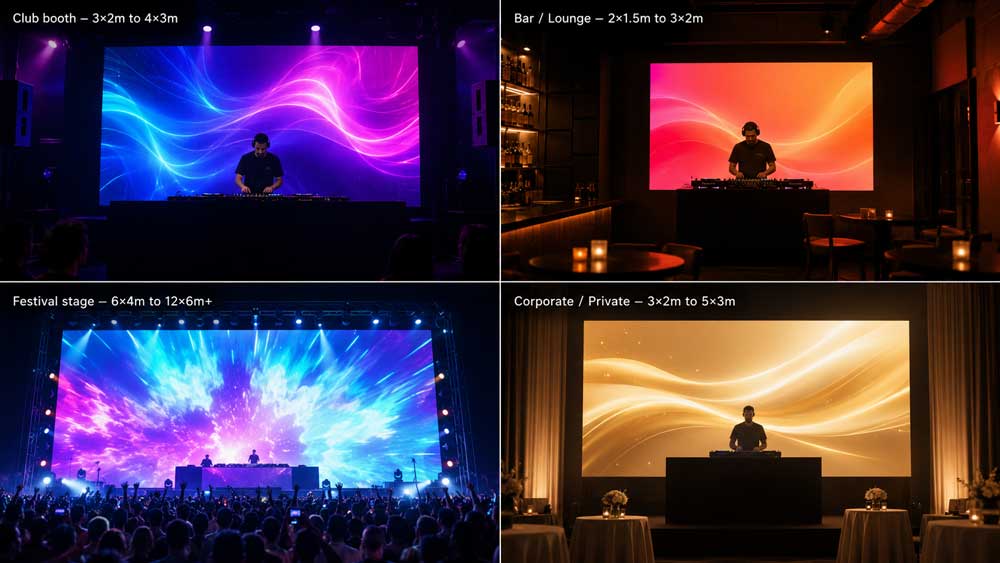
Here are practical size references for common DJ setups:
• Club booth backdrop: 3×2m to 4×3m works for most mid-size clubs. This covers the booth visually without dominating the room.
• Bar or lounge: 2×1.5m to 3×2m is usually enough. Audiences are close, so a smaller screen with finer pixel pitch makes more sense than going large.
• Festival stage: 6×4m is a reasonable starting point for mid-size outdoor stages. Larger productions go up to 12×6m or beyond.
• Corporate or private events: Size varies, but 3×2m to 5×3m covers most indoor event spaces.
One more thing to keep in mind: LED screens are modular, so the final size doesn’t have to match a standard dimension. You can build to the exact width and height your space needs.
4. Indoor vs. Outdoor DJ LED Video Wall
Indoor and outdoor DJ LED screens are not interchangeable. The environment they operate in determines the brightness, protection rating, and cabinet design you need. Using the wrong type in the wrong environment leads to either washed-out visuals or unnecessary cost.
4.1 Brightness
Brightness is the biggest difference between indoor and outdoor DJ LED displays.
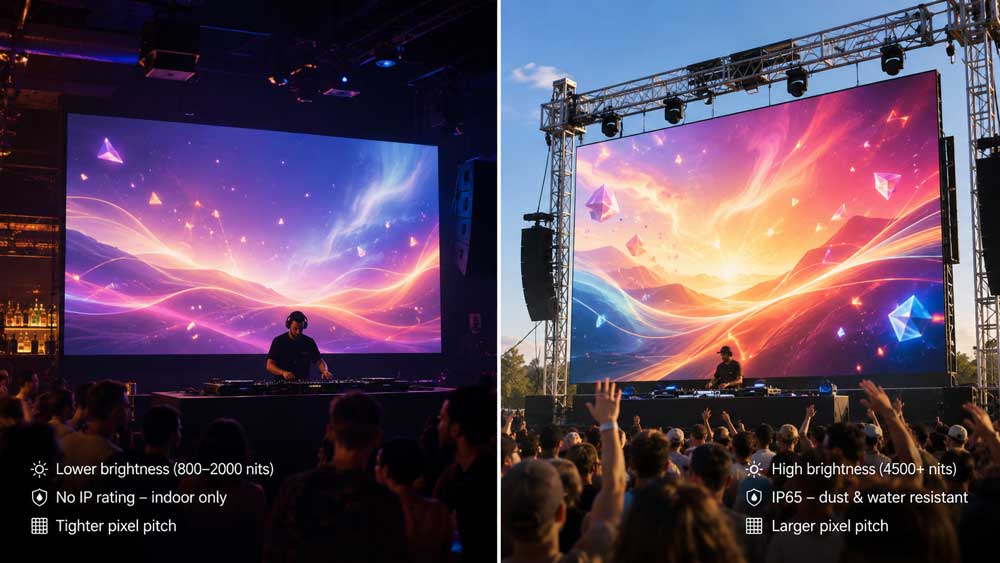
Indoor screens operate in controlled lighting conditions. A brightness range of 800–2,000 nits is enough for most club and bar environments. Going higher than that indoors is overkill — and it puts unnecessary strain on the LEDs over time.
Outdoor screens are a different story. Direct sunlight and stage wash lighting work against the screen. To stay visible, outdoor DJ LED walls need at least 4,500 nits. High-end outdoor panels reach 5,500 nits or above.
4.2 IP Rating
Outdoor DJ LED screens need at least IP65 protection. Indoor screens don’t require weather-resistant cabinets.
Indoor DJ LED screens generally don’t require a high IP rating. Most indoor panels are open-back cabinets designed for ventilation, not weather resistance.
Outdoor screens need at least IP65. That means the cabinet is fully dust-tight and protected against water jets from any direction. If you’re running a festival stage or an open-air event, IP65 is the minimum you should accept — not a premium feature.
Some series, like the MX, carry IP65 ratings on both the front and rear of the cabinet. That makes them practical for both indoor and outdoor use without switching between two separate product lines.
4.3 Pixel Pitch
Outdoor DJ LED screens can use larger pixel pitch than indoor screens because viewing distances are greater. So outdoor DJ LED screens can use a larger pixel pitch without any visible loss in quality.
For most outdoor festival stages, P3.91 to P4.81 covers the viewing distances involved. Indoor setups, where the audience is closer, typically need P2.604 to P3.91 for the same visual quality.
4.4 A Quick Reference
| Features | Indoor | Outdoor |
Brightness | 800 – 2,000 nits | 4,500 – 5,500 nits |
IP Rating | Not required | IP65 minimum |
Pixel Pitch | P1.953 – P3.91 | P2.976 – P4.81 |
Cabinet Design | Open or semi-sealed | Fully sealed |
5. DJ LED Screen Price
DJ LED screen prices typically range from $600 to $1,500 per square meter, depending on pixel pitch, screen size, and whether the setup is indoor or outdoor. A standard 4×3m club booth configuration in P3.91 generally falls between $15,000 and $30,000 for the full system.
That’s a wide range. So here’s what actually drives the price up or down.
5.1 What Affects the Price
✔ Pixel pitch
This is the single biggest cost factor. Smaller pixel pitch means more LEDs per square meter — and more LEDs means higher cost. A P3.91 panel has around 65,000 LEDs per square meter. A P1.8 panel has over 300,000. That difference shows up directly in the price per sqm.
✔ Screen size
Larger screens cost more — but not always proportionally. Some configurations get more cost-efficient at scale. Others, like custom curved builds, get more expensive as size increases because of the additional hardware involved.
✔ Indoor vs. outdoor
Outdoor DJ LED walls cost more than indoor equivalents at the same pixel pitch. The sealed cabinet design, higher brightness components, and IP65 protection all add to the unit cost.
✔ Control system
The screen itself is only part of the cost. A video processor, sending cards, and cabling add to the total. For a standard setup, budget an additional 10–20% on top of the panel cost for control hardware.
✔ Custom shapes
Curved or non-standard builds require additional hardware — curve locks, custom frames, and more complex installation. These configurations sit at the higher end of the DJ LED wall price range.
5.2 Price Reference by Configuration
Configuration | Pixel Pitch | Approx. Price Range |
Small booth backdrop (3×2m) | P3.91 | $10,000 – $18,000 |
Standard club setup (4×3m) | P3.91 | $15,000 – $30,000 |
High-res indoor setup (4×3m) | P2.604 | $25,000 – $45,000 |
Mid-size festival stage (6×4m) | P3.91 | $35,000 – $60,000 |
Custom curved booth | P2.976 – P3.91 | Varies |
These figures reflect market ranges for complete systems. Final pricing depends on the specific series, control hardware, and any customization involved.
For an accurate DJ LED screen price based on your exact dimensions and specs, the LedInCloud – LED Screen Cloud Platform lets you configure and price your setup directly — no waiting on a quote.
6. Connecting to Your DJ Setup
Connecting a DJ LED screen requires three things: a content source, a video processor or sending card, and the right cables between them. A direct HDMI cable from your laptop to the screen is not enough — LED screens don’t work that way.
6.1 The Signal Chain
Here’s how the signal flows from your computer to the screen:
Content source → Video processor → LED cabinets
Your laptop or media server runs the VJ software and outputs video via HDMI or DisplayPort. That signal goes into a video processor — such as the NovaStar VX series — which converts it into a data signal and distributes it to each cabinet through standard Cat5e or Cat6 Ethernet cables. Each cabinet has a receiving card inside that picks up the signal and drives the LEDs. The delay between your software output and what appears on screen is well under one frame — not something your audience will notice.
That’s the full chain. Miss any part of it and nothing displays.
6.2 What You Need
Before you connect anything, make sure you have these four components ready.
- A laptop or media server is your content source — this is where your VJ software runs and your video output comes from.
- A video processor or sending card sits between your computer and the screen. Most first-time buyers overlook this piece, but without it nothing displays.
- Cat5e or Cat6 Ethernet cables carry the signal from the processor to each cabinet group. The number of runs depends on your processor’s output port count.
- Power cables connect directly to each cabinet. Every cabinet needs its own power connection — there’s no daisy-chaining on the power side.
6.3 Compatible Software
Most professional VJ software works with DJ LED video walls as long as it can output video to an external display. The most widely used options are:
- Resolume Avenue / Arena — the industry standard for club and festival visual setups. Outputs video directly to the processor via HDMI or DisplayPort.
- Arkaos MediaMaster / GrandVJ — popular in the live events industry, works well with LED screen setups.
- TouchDesigner — favored for generative and interactive visuals. Steeper learning curve, but highly flexible.
- Serato Video — a video plugin for Serato DJ that adds video mixing to your existing DJ workflow. Outputs via HDMI into the video processor.
The software itself doesn’t communicate directly with the LED screen. It outputs a video signal, and the video processor handles everything from there. So compatibility is rarely an issue — if the software can output to a second screen, it works.
7. Installation and Touring
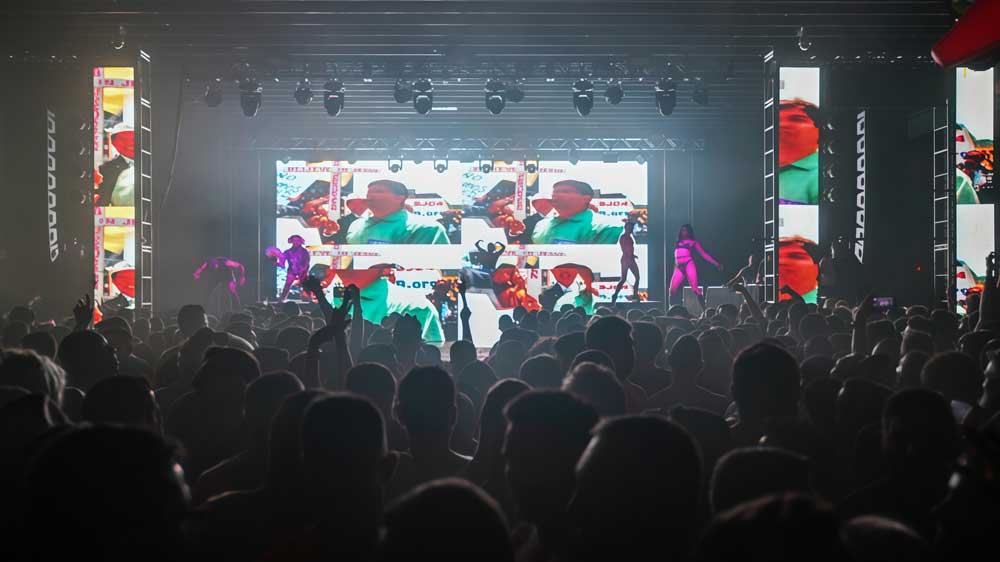
A standard 4×3m DJ LED screen takes 45 to 60 minutes to set up with a crew of two to three people using a quick-lock modular system. Most modular rental panels use a quick-lock system — no tools needed for assembly. A standard 4×3m setup with an experienced crew of two to three people takes roughly 45 to 60 minutes from unpacking to powering on.
7.1 Setup and Pack-down
The basic installation process follows the same steps regardless of screen size:
(1) Set up the support structure — either a base frame for ground stacking, or a truss system for hanging. For hanging setups, use rigging rated for at least 1.5 times the total screen weight and always have a qualified rigger handle the flying hardware.
(2) Connect the cabinets — panels lock together using the built-in locking mechanism on each side
(3) Run the cables — power cables to each cabinet, Ethernet cables from the sending card to the first cabinet in each row
(4) Power on and calibrate — connect the video processor, load your configuration, and check the display
Pack-down follows the same steps in reverse. With magnetic front panels — like those on the MY series — individual panels detach in under five seconds without tools. That speeds up the process significantly on back-to-back show nights.
7.2 Weight and Transport
Cabinet weight is one of the most practical considerations for a LED screen for DJ touring use. Here’s what the main series weigh:
| Series | 500×500mm Cabinet | 500×1000mm Cabinet | Thickness |
| MY Series | 6kg | 11kg | 80mm |
| MS Series | 7.25kg | 12.5kg | 80mm |
For a 4×3m screen using 500×500mm cabinets, that’s 48 panels. At 6kg per panel with the MY series, the total panel weight comes to around 288kg — before cases and hardware.
Standard flight cases fit both 500×500mm and 500×1000mm cabinets. Most touring DJs pack panels in groups of 6 to 10 per case depending on weight limits and vehicle space.
8. FAQs
What happens if a panel stops working mid-show?
The rest of the screen keeps running. Because DJ LED screens are modular, a single cabinet failure affects only that section — not the entire display. Most rental-grade panels support front-access maintenance, so a faulty module can be swapped out quickly without disassembling the whole screen.
Do I need a technician on-site during the event?
For a straightforward single-source setup, an experienced operator can run the screen without dedicated technical support. Once the system is configured and content is loaded, day-to-day operation is manageable. For more complex setups — multiple inputs, live camera feeds, real-time switching — having a dedicated operator on-site reduces the risk of something going wrong during the show.
Can I display live camera feeds on the screen?
Yes. Video processors like the NovaStar VX series accept multiple input sources, including live camera feeds via HDMI or SDI. You can switch between pre-loaded content and live feeds in real time during the show.
Can I run the screen without a laptop?
Yes, but with limitations. Some video processors support built-in media playback from a USB drive or SD card. That works for simple looping content. For full VJ software control — live mixing, beat-synced visuals, real-time effects — you still need a computer in the signal chain.
How long does a DJ LED screen last?
LED chips are typically rated for 100,000 hours of operation. Under regular use — say, four to five shows per week — that translates to well over ten years before noticeable brightness degradation. Cabinet durability depends more on how the screen is handled during transport and installation than on the LEDs themselves.
9. Conclusion
Choosing the right DJ LED screen comes down to a few key decisions: pixel pitch based on your viewing distance, brightness based on indoor or outdoor use, and a cabinet series that fits how you work — whether that’s a fixed club installation or a touring rig that moves every weekend.
The rest — software compatibility, setup time, panel weight — follows from those core choices. Get the fundamentals right and everything else falls into place.
If you’re still working out the numbers, the LedInCloud platform lets you configure your screen by venue type, dimensions, and pixel pitch and get real-time pricing without waiting on a quote. It’s the fastest way to go from “roughly this size” to an actual figure you can budget around.
More Solutions
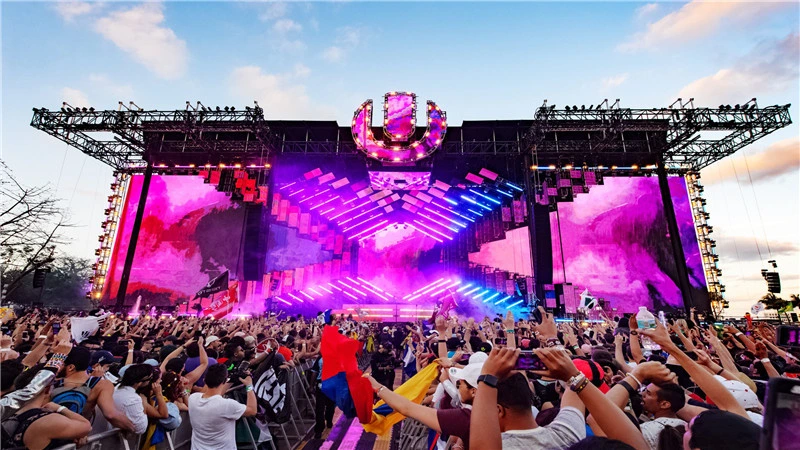
Event LED Screen
Delivering sharp visuals, smooth playback, and quick installation, making every gathering more engaging and memorable.

3D LED Screen
Eye-catching naked-eye 3D visuals that attract crowds and boost brand exposure in outdoor spaces.

Stage LED Screen
Dynamic visuals for concerts, events, and live shows, offering vivid effects and seamless synchronization.
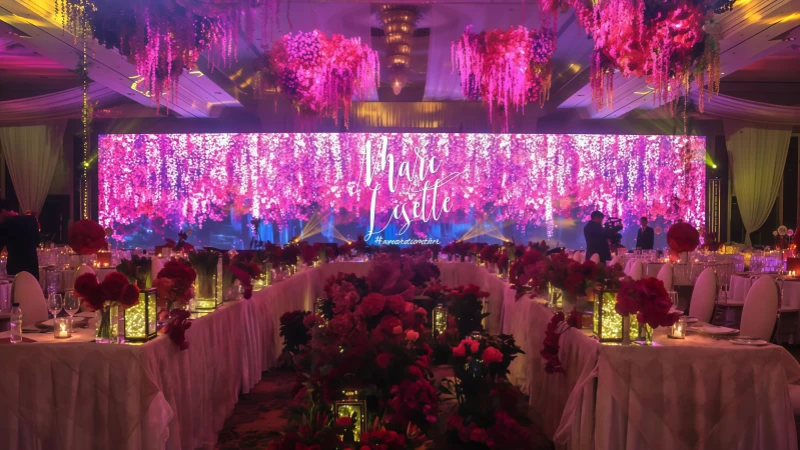
Wedding LED Screen
Creating a stunning backdrop and romantic atmosphere, making every moment unforgettable.