
NovaStar MRV532: A Practical Receiving Card for Indoor LED Displays
NovaStar MRV532 is a receiving card designed for LED display systems that require stable signal transmission and consistent image performance.
What does this receiving card do? How much resolution can it handle? And where does it make sense to use it? This article focuses on those questions.
Table of Contents
1. What Is the NovaStar MRV532?
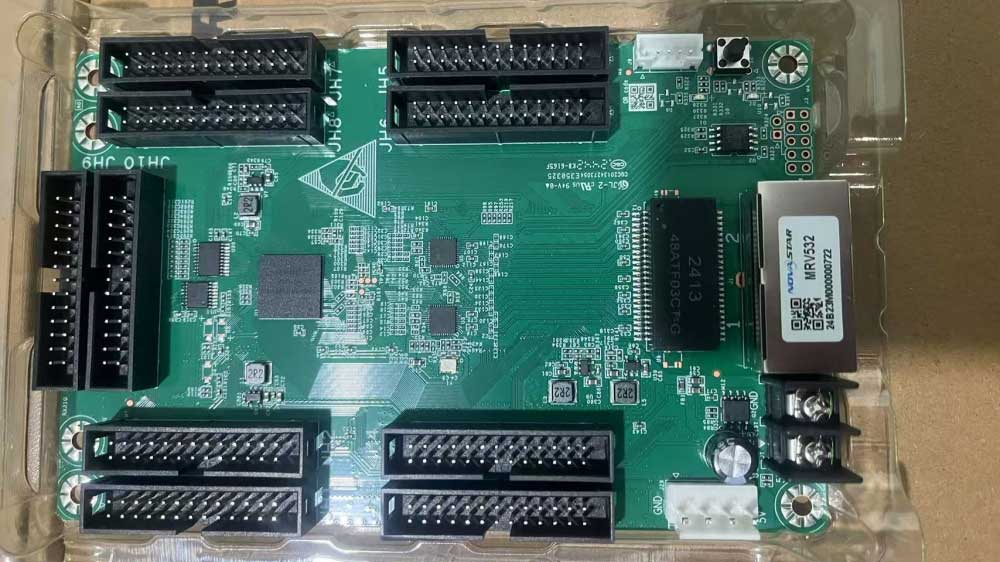
The NovaStar MRV532 is a receiving card developed by NovaStar Technology for LED display applications. It works as part of a complete LED control system and is used together with compatible sending controllers, such as M3 and NovaStar COEX series controllers.
In an LED display, the sending device outputs video data through Ethernet. The MRV532 receives this data and distributes it to LED modules through HUB interfaces. Each receiving card controls a defined area of the screen. Multiple cards are usually cascaded to drive larger displays.
2. NovaStar MRV532 Core Features
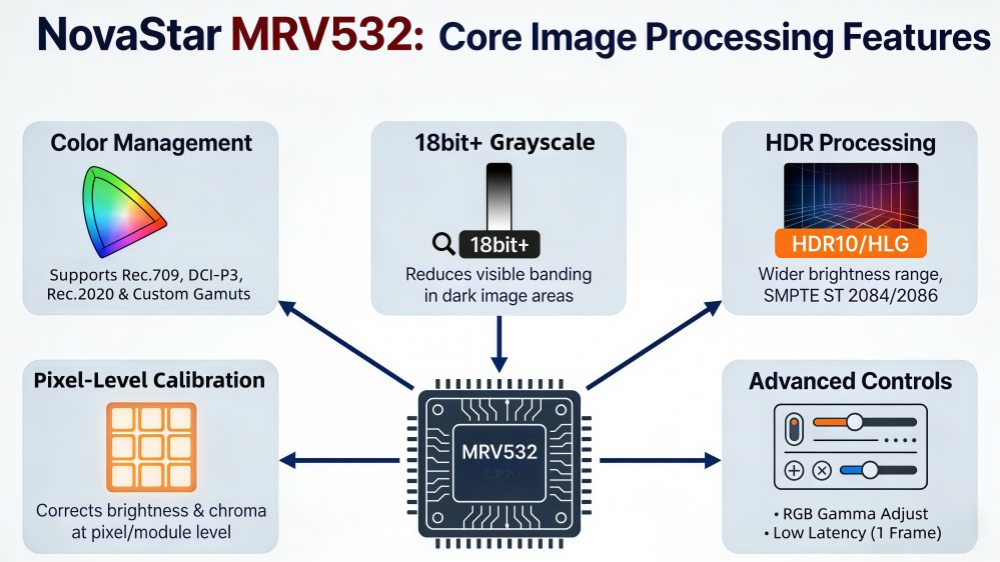
The core features of the NovaStar MRV532 focus on image processing at the receiving card level. These functions directly affect how an LED screen looks after installation.
- Image Processing and Color Control
The MRV532 supports color management for LED displays. It works with standard color gamuts such as Rec.709, DCI-P3, and Rec.2020, as well as custom gamuts configured through NovaStar software. This allows the display system to match different content requirements rather than relying on a fixed color space.
- 18bit+ Grayscale Performance
Grayscale handling is one of the areas where differences between receiving cards become noticeable, especially at low brightness levels.
The MRV532 supports 18bit+ grayscale processing. According to the official specification, this improves grayscale precision compared with standard processing and helps reduce visible banding in dark areas of the image.
- HDR Support
The MRV532 supports HDR10 and HLG formats. HDR10 support follows SMPTE ST 2084 and ST 2086 standards.
HDR processing allows the display system to handle a wider range of brightness levels within the same image. On LED screens, this mainly improves contrast and detail in scenes that include both bright and dark areas.
- Pixel-Level Brightness and Chroma Calibration
The MRV532 works with NovaStar’s calibration system to support pixel-level brightness and chroma calibration. Calibration data is applied at the receiving card level, helping reduce visible differences between pixels, modules, and cabinets.
- Additional Display Control Functions
In addition to the main image processing features, the MRV532 supports several practical display control functions:
- Individual RGB gamma adjustment, allowing separate control of red, green, and blue gamma values
- Quick adjustment of dark or bright lines, used to correct visible seams caused by module or cabinet splicing
- 90-degree image rotation, supporting 0°, 90°, 180°, and 270° orientations
- Low-latency operation, with latency reduced to one frame when used with driver ICs that include built-in RAM
Taken together, these core features show that the NovaStar MRV532 is designed to handle more than basic signal distribution. Its role is to manage image quality at the receiving card level, where small differences can have a visible impact on the final LED display.
3. Load Capacity and Resolution
When working with the NovaStar MRV532, load capacity is one of the first technical limits that needs to be understood.
3.1 Load Capacity with PWM Driver ICs
When the MRV532 is used with PWM driver ICs, it supports higher load capacity compared with common driver ICs.
- With M3 controllers
- Up to 512 × 512 @ 60Hz for 8-bit video sources
- Up to 512 × 384 @ 60Hz for 10-bit and 12-bit video sources
- With COEX controllers
- Up to 512 × 512 @ 60Hz for 8-bit and 10-bit video sources
- Up to 512 × 384 @ 60Hz for 12-bit video sources
3.2 Load Capacity with Common Driver ICs
When paired with common driver ICs, the load capacity of the MRV532 is lower. This is expected and follows the same logic of signal bandwidth and processing limits.
- With M3 controllers
- Up to 512 × 384 @ 60Hz for 8-bit video sources
- Up to 256 × 384 @ 60Hz for 10-bit and 12-bit video sources
- With COEX controllers
Up to 512 × 384 @ 60Hz for 8-bit and 10-bit video sources
Up to 256 × 384 @ 60Hz for 12-bit video sources
4. Signal Interfaces and Hardware Design
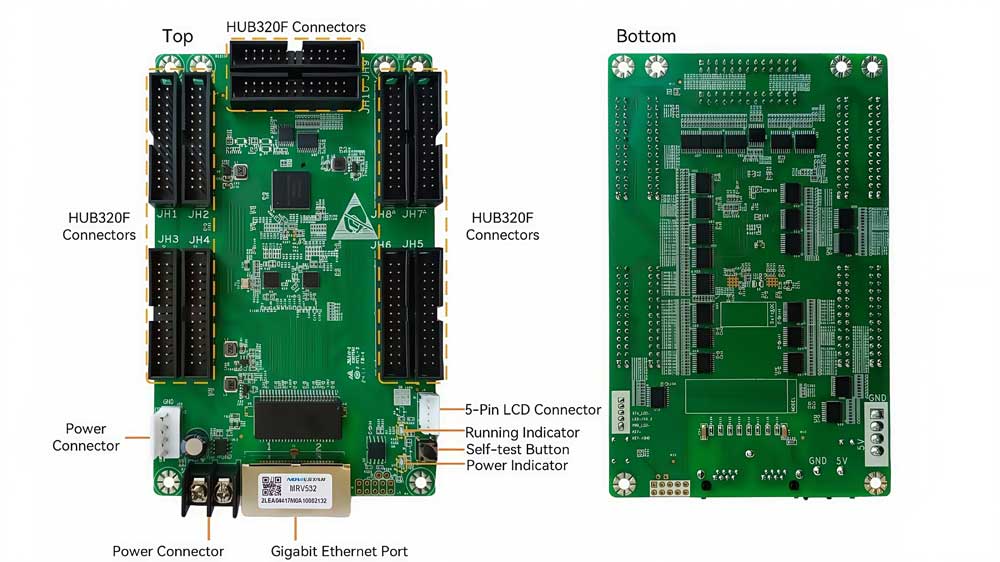
NovaStar MRV532 provides 10 standard HUB320F connectors, which are used to connect LED modules. These interfaces support different data configurations, including:
- Up to 40 groups of RGB real pixel data
- Up to 40 groups of 3-LED sub-pixel data
- Up to 30 groups of 4-LED sub-pixel data
This flexibility allows the MRV532 to work with a wide range of indoor LED modules without changing the basic system architecture.
- Ethernet Ports and Cascading
The MRV532 includes Gigabit Ethernet ports for signal input and output. Each port can be used flexibly as either an input or an output, making it easier to cascade multiple receiving cards in large displays.
The card also supports loop backup at the system level. When configured with compatible controllers, this allows the signal path to form a loop. If a cable fault occurs at one point, the display can continue operating through the backup path.
- Line Decoding and Signal Details
The MRV532 supports line decoding signals A, B, and C. It does not support D and E signals. This is a technical detail that matters when matching the receiving card with specific LED module designs.
Ignoring line decoding compatibility during system design can lead to unnecessary troubleshooting later, so this limitation should be confirmed during the planning stage.
5. Typical Applications of the NovaStar MRV532
The NovaStar MRV532 is mainly used in indoor LED display projects where image quality and system stability are important. It is commonly selected for applications that require consistent brightness, accurate color control, and reliable long-term operation.
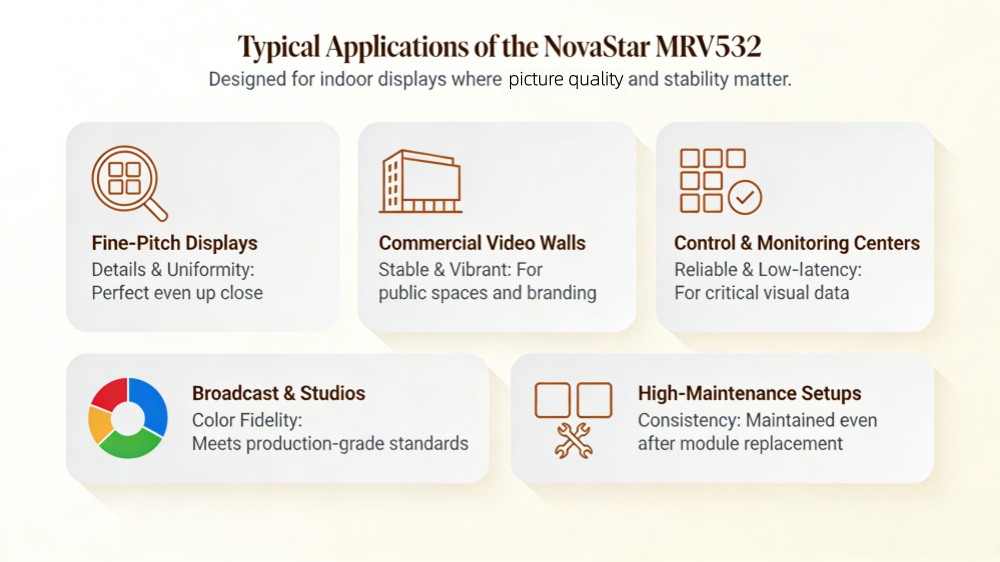
Typical use cases include:
✓ Fine-pitch indoor LED displays
Suitable for close-viewing environments where grayscale performance and uniformity are easy to notice.
✓ Commercial LED video walls
Used in shopping malls, corporate spaces, and exhibitions where stable operation and consistent image quality are required.
✓ Control rooms and monitoring centers
Applied in environments that need clear, stable visuals and low-latency signal handling.
✓ Studio and broadcast-related displays
Chosen for projects that require better control over color, grayscale, and HDR processing.
✓ Indoor displays with frequent maintenance
Helpful in installations where module replacement is more common and consistency after maintenance matters.
Overall, the MRV532 fits indoor LED display systems that go beyond basic signal distribution and place higher demands on image control and reliability.
6. Price Range and Cost Considerations
The price of the NovaStar MRV532 is not fixed. In real projects, the final cost usually depends on several factors rather than the receiving card alone.
Common factors that influence pricing include:
- Order quantity
- Project scale and configuration
- Controller and system compatibility
- Regional supply and delivery conditions
For a more accurate reference, users can check current availability and pricing through LedInCloud. Register LedInCloud, it is possible to view product details, compare, and access updated information based on real supply conditions.
7. Technical Resources and Downloads
When working with receiving cards like the NovaStar MRV532, access to the right technical documents is often just as important as the hardware itself.
Instead of searching across multiple sources, all of NovaStar’s resources can be found in one place through the NovaStar Software page. This page is designed as a centralized library for NovaStar products, making it easier to locate updated files and technical references.
8. Conclusion
The NovaStar MRV532 is a receiving card designed for indoor LED display systems where image quality and stable operation are important.
For further evaluation, just contact LedInCloud at any time.