

Mini LED vs Micro LED Display: Which One Is Right for You?
Mini LED vs Micro LED — if you’ve been researching display technology lately, you’ve probably seen both terms everywhere.
The names look similar, but the technologies work in completely different ways. One is an upgrade to a system that’s been around for decades. The other throws out the old approach entirely.
This guide covers what each technology actually is, how they compare across the specs that matter, and which one makes sense depending on what you’re building.
Table of Contents
1. What Is Mini LED Display Technology?
To understand how Mini LED stacks up against Micro LED, you first need to know what it actually is — and what it’s built on.
1.1 What Is Mini LED?
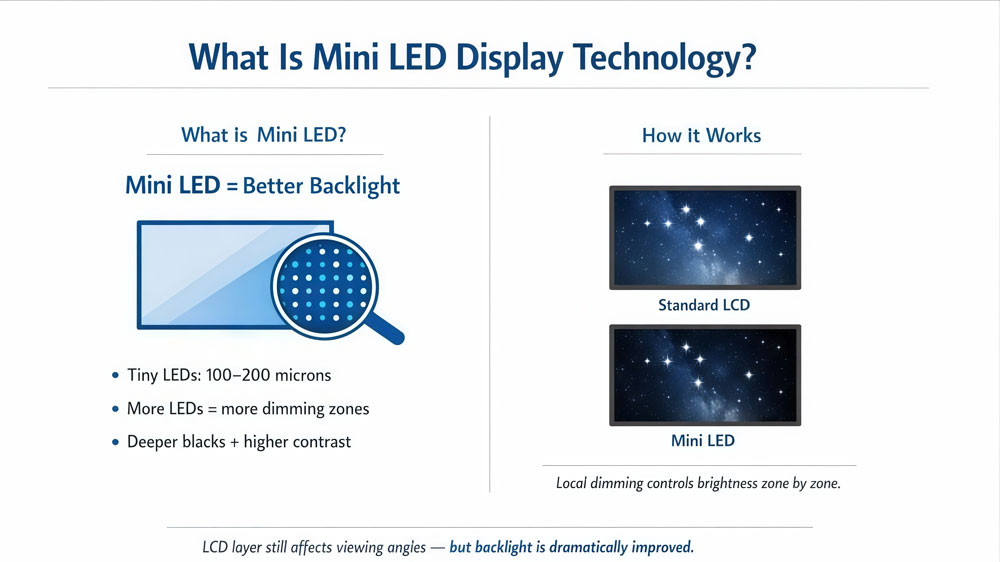
Mini LED is not a brand-new display technology. It’s an upgrade to LCD — more specifically, an upgrade to the backlight system behind the screen.
Here’s the problem with standard LCD: the backlight is divided into a limited number of zones. When part of the image needs to go dark, the whole zone dims. So blacks never look truly black — they look more like dark grey.
Mini LED fixes this by making each backlight LED much smaller, around 100–200 microns, and packing far more of them into the same space. More LEDs means more dimming zones. More zones means tighter control over brightness across the screen. The result is better contrast, deeper blacks, and higher peak brightness — without reinventing the manufacturing process.
1.2 How Does Mini LED Work?
So how does that play out in practice? It comes down to local dimming.
A Mini LED display has three layers: the LCD panel on top, a color filter, and the Mini LED backlight array behind it. That backlight is split into hundreds or even thousands of independent zones. Each zone adjusts its brightness based on what’s showing in that part of the image.
Bright areas get more light. Dark areas get less. Because the zones are small and tightly packed, the transitions between light and dark are much cleaner than on a standard LCD panel.
One thing to keep in mind though — the LCD layer is still there. Mini LED improves the backlight, but it doesn’t change the fundamental nature of liquid crystal technology. Things like viewing angle and response time are still shaped by that LCD layer.
2. What Is Micro LED Display Technology?
Micro LED is a completely different story. While Mini LED improves what’s behind the LCD panel, Micro LED gets rid of the panel altogether.
2.1 What Is Micro LED?
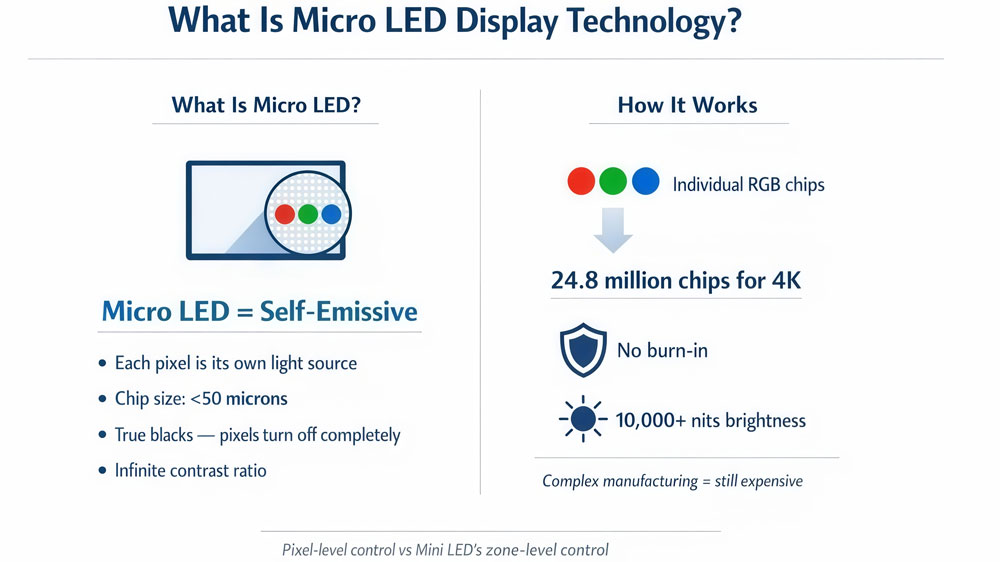
Micro LED is a self-emissive display technology. That means every single pixel produces its own light — no backlight, no LCD layer, no color filter needed.
Each pixel is an individual LED chip, smaller than 50 microns. When a pixel needs to show black, it simply turns off. Completely. That’s fundamentally different from Mini LED, where a zone dims down but never fully shuts off.
Think of it this way: Mini LED controls light in groups. Micro LED controls light one pixel at a time.
That pixel-level control is what gives Micro LED its near-infinite contrast ratio, true black levels, and exceptional brightness ceiling — some commercial panels hit 10,000 nits and beyond.
2.2 How Does Micro LED Work?
Here’s where things get technically impressive — and technically challenging.
To build a Micro LED display, manufacturers take millions of microscopic LED chips and transfer them onto a substrate with extreme precision. A single 4K Micro LED panel requires around 24.8 million individual chips, each placed in exactly the right position. Red, green, and blue chips sit side by side at the pixel level, each firing independently based on the image signal.
Because there’s no organic material involved — unlike OLED — Micro LED doesn’t degrade over time the same way. No burn-in. No gradual colour shift. Just stable, consistent output over a very long lifespan.
The catch? That manufacturing process is extraordinarily complex.
Placing tens of millions of chips at microscopic scale, with near-zero defect tolerance, pushes current production technology to its limits. That’s the main reason Micro LED is still expensive and not yet the default choice for most projects.
3. Mini LED vs Micro LED: Key Differences at a Glance
Those numbers give you a quick snapshot — what do they actually mean when a display is running in a real environment?

| Feature | Mini LED | Micro LED |
| Chip Size | 100–200μm | <50μm |
| Light Source | LCD backlight | Self-emissive per pixel |
| Peak Brightness | 2,000–4,000 nits | 5,000–10,000+ nits |
| Contrast Ratio | High (~1,000,000:1) | Near-infinite |
| True Black | No (zone-based dimming) | Yes (pixel-level off) |
| Viewing Angle | Good | Excellent |
| Response Time | Fast | <1ms |
| Power Efficiency | Moderate | Up to 40% lower than LCD |
| Scalability | Limited | Highly flexible |
| Lifespan | 50,000–100,000 hrs | 100,000+ hrs |
| Burn-in Risk | Low | None |
| Mass Production | Mature | Still limited |
| Cost | Moderate | Significantly higher |
On paper, Micro LED wins on almost every spec. But specs don’t tell the whole story. How these two technologies actually perform in real environments — and what that means for your project — is where things get more meaningful.
4. Mini LED vs Micro LED: Head-to-Head Comparison
Both technologies have their strengths. But how they perform in real environments is where the differences become clear. Here’s a breakdown across every dimension that matters for a commercial display project.
4.1 Brightness and Contrast
Mini LED panels typically deliver peak brightness between 2,000 and 4,000 nits. For most commercial environments, that’s more than enough. But brightness isn’t really where the gap shows up.
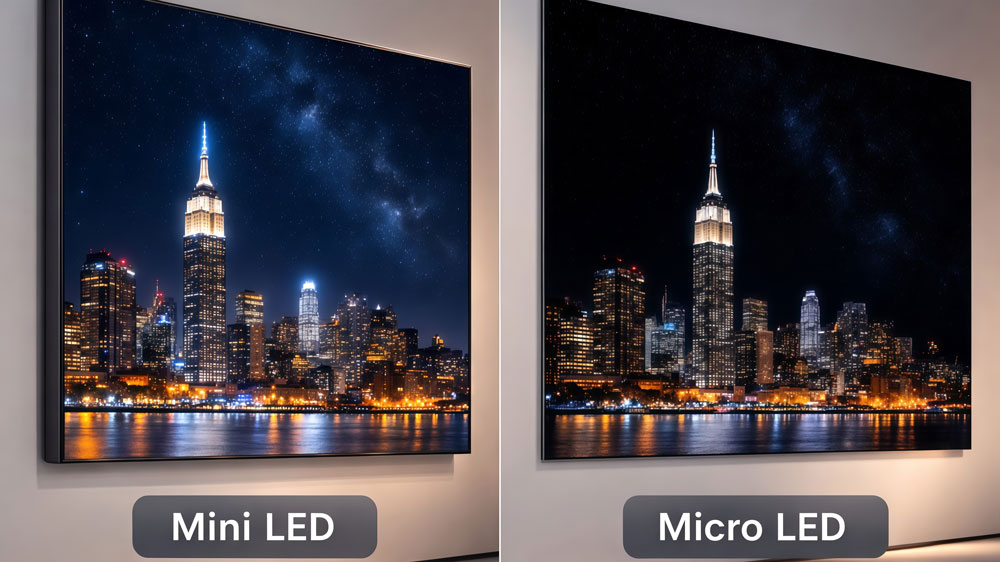
The real difference is contrast. Here’s why:
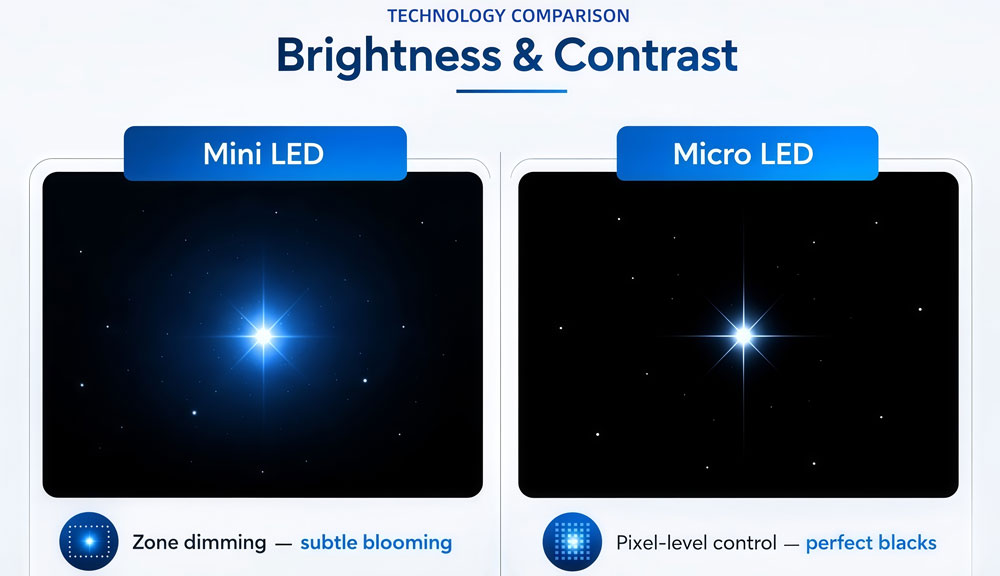
- Mini LED: use zone-based dimming. A bright object near a dark background can cause a faint glow around the edges — known as blooming. It's subtle, but it's there.
- Micro LED: control each pixel independently. When a pixel goes black, it fully shuts off. No glow, no bleed, no compromise.
In bright retail or office environments, you probably won’t notice the difference. But in dark viewing spaces — immersive exhibitions, screening rooms, museum installations — Micro LED’s true black levels are immediately visible.
4.2 Viewing Angle
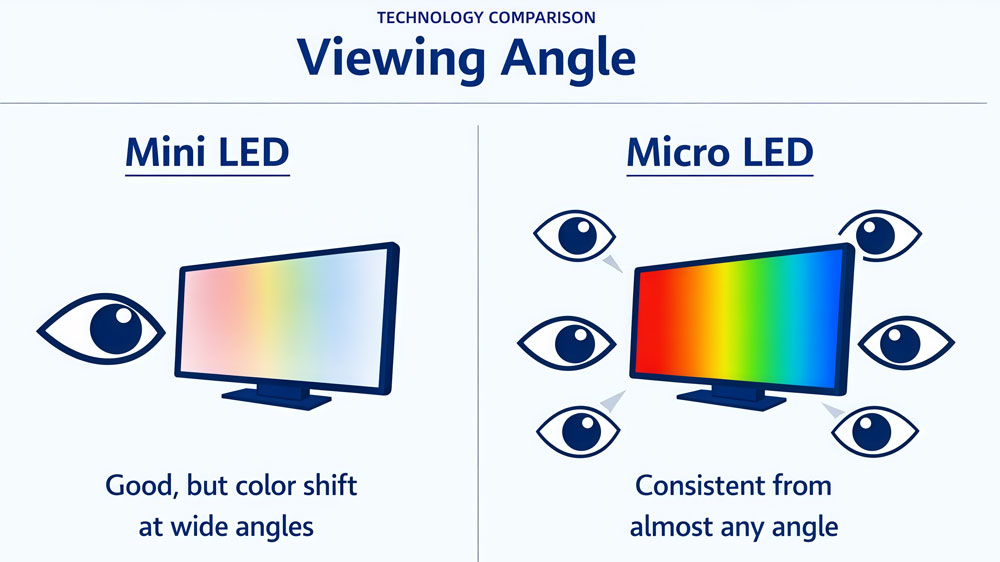
Mini LED still relies on an LCD layer, which comes with some viewing angle limitations. Colors and contrast can shift when viewed from the side.
Micro LED emits light directly from each pixel, so the image stays consistent across a much wider cone. For displays that need to look good from multiple directions — lobby walls, trade show booths, open retail floors — this matters.
- Mini LED: good viewing angles, but with some colour shift at wider angles.
- Micro LED: consistent image quality from almost any direction.
4.3 Response Time
- Mini LED: fast, but not class-leading
- Micro LED: under 1ms
For standard signage or corporate displays, you won’t notice the difference. But for live broadcast studios, esports arenas, or fast-moving content environments, Micro LED’s response time gives it a clear edge.

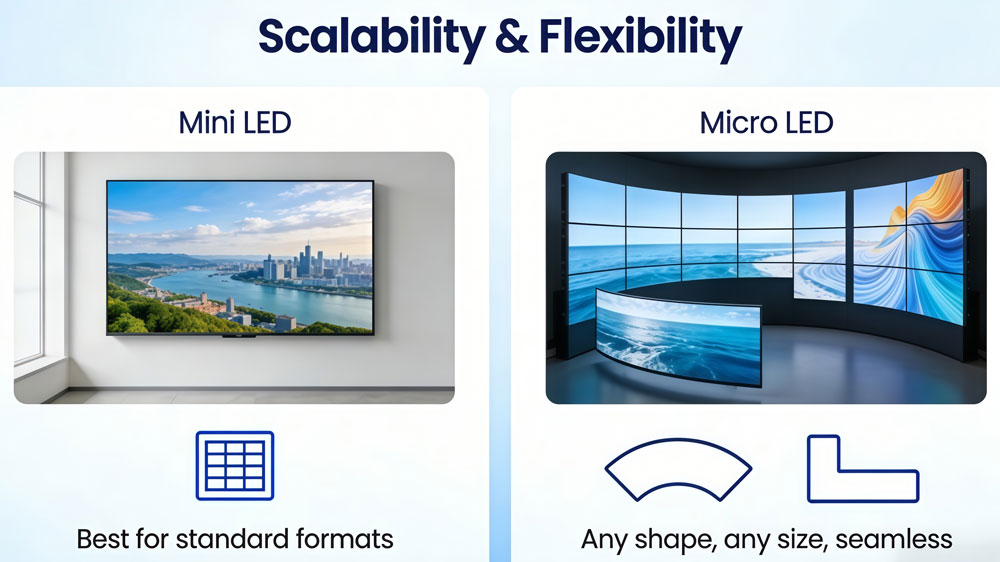
4.4 Scalability and Flexibility
- Mini LED
Mini LED works well for standard formats. But large-scale or irregular installations are harder to execute cleanly because of its panel-based structure.
- Micro LED
Micro LED’s modular structure means it can be configured in almost any shape or size — standard rectangles, custom aspect ratios, curved surfaces, or seamless video walls beyond 500 inches diagonally.
4.5 Power Consumption and Heat
- Mini LED
Mini LED’s backlight layer runs continuously regardless of what’s on screen, so baseline power consumption stays higher.
- Micro LED
Because Micro LED controls each pixel independently, dark pixels draw almost no power. That efficiency advantage can translate to up to 40% lower power consumption compared to LCD-based displays.
For 24/7 commercial installations, that adds up:
- Less power draw
- Less heat generated
- Lower cooling requirements
- Reduced long-term operating costs
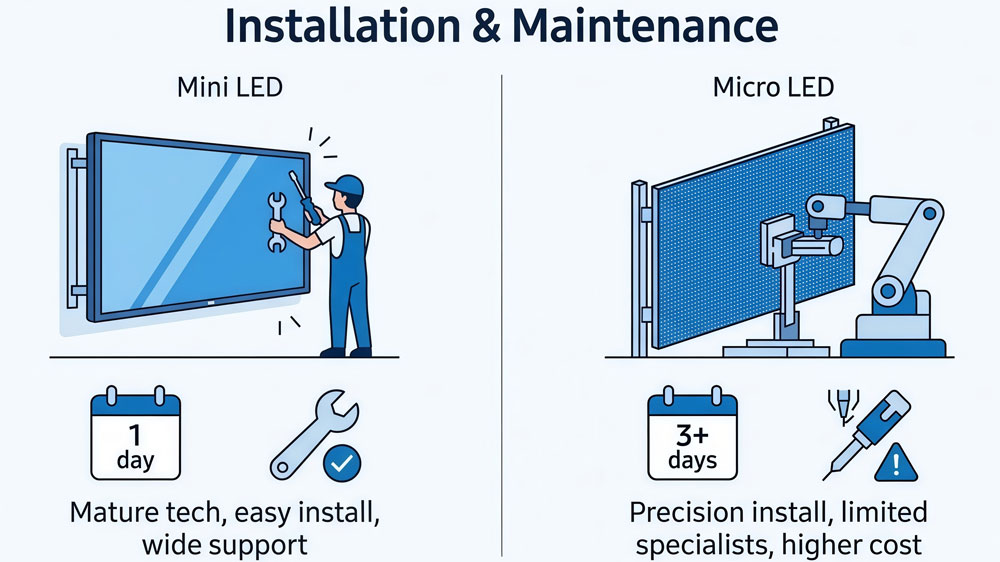
4.6 Installation and Maintenance
- Mini LED
- Mature technology with well-established installation processes
- Wide network of experienced service providers
- Standardized modules, easy to source and replace
- Better choice for tight timelines or locations needing reliable local support
- Micro LED
- More demanding installation with stricter alignment requirements
- Experienced installation teams are still relatively limited
- Post-installation repairs take longer and cost more
- Better suited for projects with dedicated technical resources
4.7 Lifespan
| Mini LED | Micro LED | |
| Rated lifespan | 50,000–100,000 hrs | 100,000+ hrs |
| Burn-in risk | Low | None |
| Material degradation | Minor over time | No organic materials to degrade |
For permanent installations in high-traffic environments, Micro LED’s long-term stability is worth factoring into total cost of ownership — not just the upfront price.

5. Mini LED vs Micro LED: Cost and Availability
Cost is still where Mini LED wins for most buyers. But the gap is shifting. Here’s where things actually stand now.
- Mini LED
- Supply chains are mature and efficient
- Production yields are high and consistent
- Pricing has dropped steadily over the past few years
- Short delivery timelines, widely available from multiple suppliers
- A practical choice for mid-size commercial projects with standard budgets
- Micro LED
- Manufacturing costs remain high due to the complexity of chip placement
- Production yields for large-format panels are still below 70%
- Current pricing sits roughly 3–5x higher than comparable OLED panels — and significantly more than Mini LED at equivalent sizes
- Lead times are longer, supplier options are more limited
That said, things are moving. At CES 2026, more commercial Micro LED products appeared than ever before. Analysts project production costs could fall by 18–22% as defect repair processes improve and mass transfer technology matures.
So where does that leave you?
- Budget is a priority, timeline is now → Mini LED is the straightforward choice
- Flagship installation, long-term horizon, performance is non-negotiable → Micro LED is worth the investment
- Somewhere in the middle → Fine Pitch Mini LED often hits the sweet spot — closing much of the performance gap at a fraction of the Micro LED price
Not sure where to start? LedInCloud – LED Screen Cloud Platform offers a full range of LED display options — with transparent pricing and direct technical support.
6. Which One Should You Choose?
So, is Micro LED better than Mini LED? On paper, yes — it wins on almost every performance metric. But better on paper doesn’t always mean right for your project.
The honest answer is: it depends on what you’re building, where it’s going, and how long it needs to run.
Here’s a straightforward breakdown by use case:
✔ Go with Mini LED if you're working on:
🏢 Conference LED screen and corporate offices — Bright, sharp, reliable, and easy to service. Mini LED covers everything you need here without overcomplicating the budget.
🛍️ Retail stores and brand showrooms — Fine Pitch Mini LED delivers excellent image quality at a price point that makes multi-location rollouts viable.
📢 Commercial signage and advertising displays — Wide availability, fast delivery, and a proven track record in high-traffic environments.
🎬 Broadcast studios and live event backgrounds — Mini LED performs well for most studio applications where lighting conditions are controlled.

✔ Go with Micro LED if you're working on:
🎨 Immersive exhibitions and art installations — True black levels and near-infinite contrast make dark-environment displays look dramatically better.
🏦 Luxury hotels, flagship stores, and museum installations — When the display itself needs to be part of the brand experience, Micro LED delivers visual impact that Mini LED can’t quite match.
🏟️ Premium fixed installations in arenas or experience centers — Long lifespan, zero burn-in risk, and modular scalability make Micro LED a strong long-term investment for permanent high-use environments.
⚡ Esports arenas and live broadcast studios with fast-moving content — Sub-1ms response time and wide viewing angles give Micro LED a real edge here.

Still not sure? A few questions that can help you decide:
| Question | Mini LED | Micro LED |
| What’s your environment like? | Bright spaces — retail, offices, lobbies | Dark spaces — exhibitions, screening rooms, museums |
| How long will it run? | Standard commercial hours | 24/7 permanent installations |
| What’s your total budget? | Moderate — including installation and maintenance | Higher upfront, lower long-term operating costs |
| How fast do you need it deployed? | Fast — mature supply chain, short lead times | Longer lead times, more limited supplier options |
7. FAQs
Q1. Is Micro LED better than Mini LED?
On pure display performance, yes. Micro LED delivers better contrast, truer blacks, wider viewing angles, faster response times, and a longer lifespan. But it also costs significantly more and is harder to install and maintain. For many commercial projects, Mini LED’s performance is more than sufficient — and the practical advantages of lower cost, mature supply chains, and easier servicing make it the smarter choice. So “better” really depends on what your project actually needs.
Q2. What is the lifespan of Micro LED vs Mini LED?
Mini LED panels are typically rated at 50,000 to 100,000 operating hours. Micro LED exceeds 100,000 hours — and because it uses inorganic materials, there’s no organic layer to degrade over time. No burn-in, no gradual colour shift. For 24/7 commercial installations, that difference in long-term stability is worth factoring into your total cost of ownership.
Q3. Is Micro LED worth the cost for commercial display projects?
It depends on the project. For high-end permanent installations — museum displays, flagship retail environments, luxury hospitality spaces — the image quality and durability of Micro LED can absolutely justify the premium. For standard commercial deployments where budget efficiency matters and performance requirements are moderate, Mini LED delivers better value. The right answer comes down to your environment, viewing conditions, and how long you plan to run the installation.
8. Conclusion
Mini LED vs Micro LED are both solid technologies. The right choice comes down to your project, your environment, and your budget.
Mini LED is the practical option for most commercial projects today — mature, cost-effective, and easy to deploy. Micro LED is the better performer, but it comes at a price that only makes sense for the right application.
Still deciding? Explore our LED display solutions or get in touch — we’ll help you figure it out.