

How to Calculate LED Display Power Consumption and Plan Power Cables?
LED display power consumption refers to the amount of electrical power an LED screen uses during operation. It is a basic parameter used when planning power supply, cable size, and overall system capacity.
In practice, power consumption is not a single fixed number. It changes with working conditions and display content. To calculate it correctly, the underlying concepts must be clear first.
Table of Contents
1. Understanding LED Display Power Consumption
LED display power consumption describes how much power the screen draws from the electrical system while operating. This value is usually expressed in watts (W) or kilowatts (kW) and is commonly calculated based on screen area.
For engineering and planning purposes, power consumption is divided into two categories: maximum power and average power. Each represents a different operating condition and serves a different role in system design.
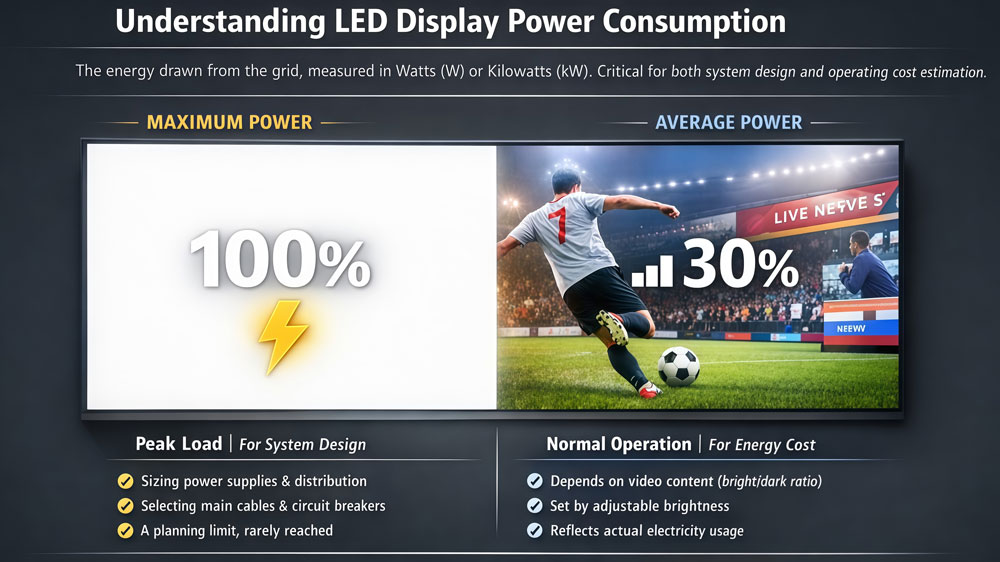
1.1 Maximum Power Consumption
Maximum power consumption refers to the highest possible power load of an LED display.
It is measured under extreme conditions, typically when the screen shows full white content at high brightness.
This value is mainly used for:
- Designing the power distribution system
- Selecting power supplies and protection devices
- Determining the capacity of main power cables
Maximum power represents a design limit rather than a daily operating state.
1.2 Average Power Consumption
Average power consumption reflects the power used during normal operation.
It depends on factors such as:
- Display brightness settings
- Video and image content
- The proportion of bright and dark areas on the screen
Under typical use, LED screens rarely reach maximum power. As a result, average power consumption is usually much lower than the maximum value and is more relevant for estimating actual energy use.
2. How to Calculate LED Screen Power Consumption?
Calculating LED screen power consumption is not complicated, but it must follow a clear order.
The goal is not to get a perfect number. The goal is to get a usable value for power planning and cable selection.
In real projects, the calculation usually includes three parts:
- Screen power itself
- System loss
- Auxiliary equipment
Each part should be considered separately.
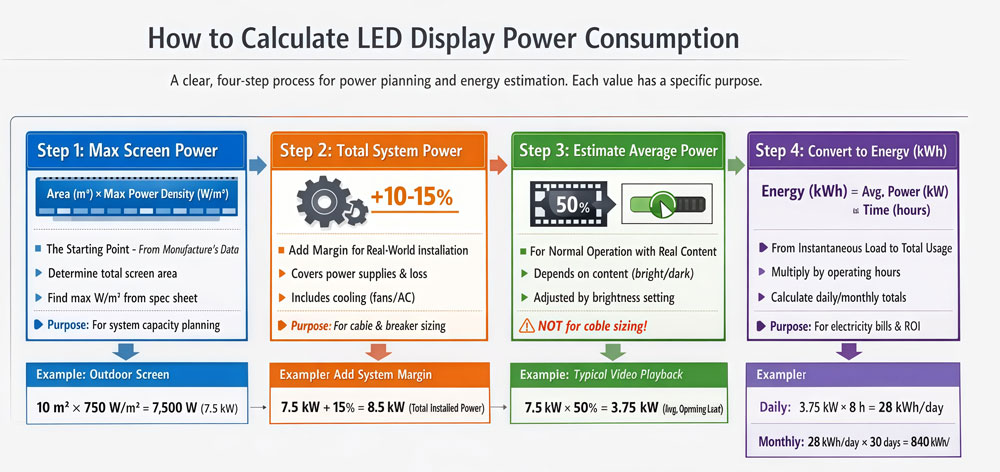
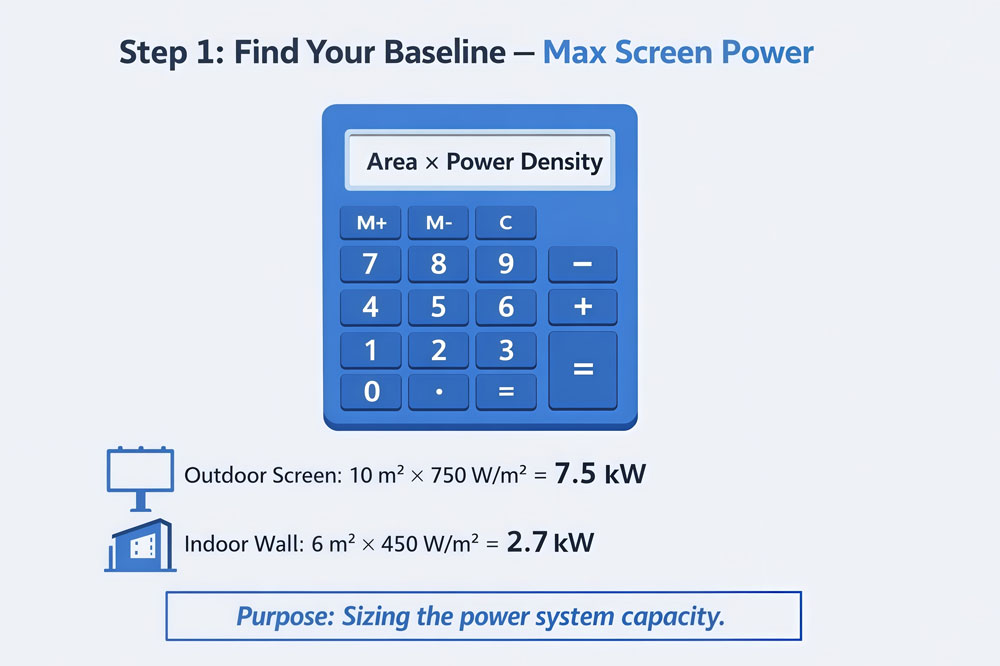
Step 1: Calculate the Maximum Power of the LED Screen
The starting point is the maximum power consumption per square meter provided by the manufacturer.
This value represents the electrical load when the screen operates under extreme conditions, such as high brightness and full white content.
- Basic Formula
- Maximum Screen Power = Screen Area × Maximum Power per Square Meter
This value represents the highest possible electrical load of the LED screen itself.
- Example 1: Outdoor LED Screen
- Screen area: 10 m²
- Maximum power per Square Meter: 750 W/m²
- Calculation: 10 × 750 = 7,500 W (7.5 kW)
This value is used as the reference for power system capacity.
- Example 2: Indoor LED Video Wall
- Screen area: 6 m²
- Maximum power per Square Meter: 450 W/m²
- Calculation: 6 × 450 = 2,700 W (2.7 kW)
Although the screen is smaller and intended for indoor use, the calculation method remains the same.
Step 2: Consider System Loss and Auxiliary Equipment
After calculating the maximum power of the LED screen itself, the next step is to consider system-level power usage.
An LED display does not operate as a single electrical load. In real installations, additional power is consumed by supporting components.
These typically include:
- Power supplies and distribution units
- Control systems
- Cooling equipment such as fans or air conditioners
In addition, power conversion loss exists in all LED display systems. Electricity is lost during AC–DC conversion and internal distribution.
Because of this, instead of calculating each auxiliary device separately, many projects apply a practical margin to the screen’ maximum power.
This margin covers:
- Power conversion loss
- Supporting equipment
- Basic operating allowance
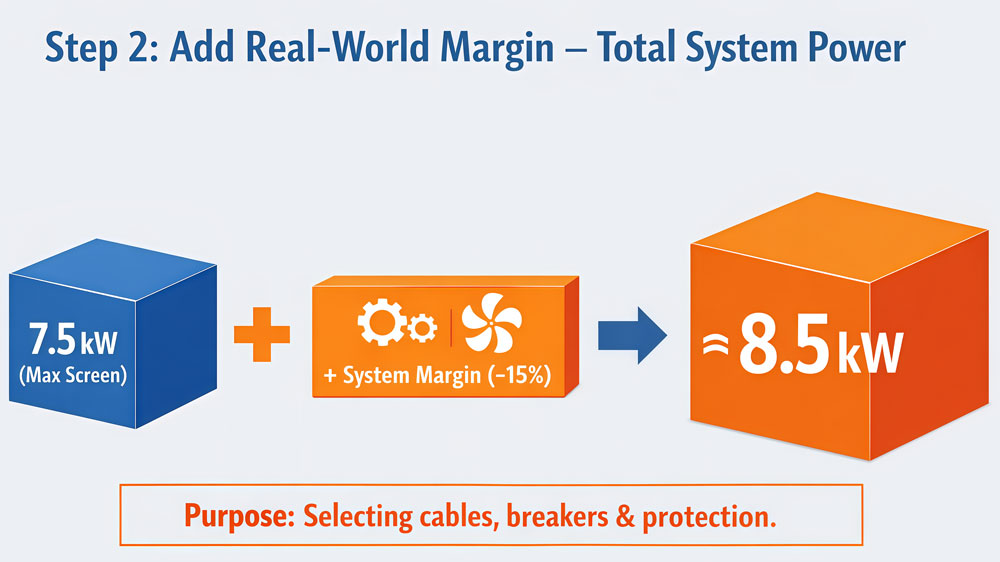
A commonly used reference value is around 10–15% above the screen’s maximum power, depending on system complexity.
- Example: 10 m² Outdoor LED Screen
- Screen area: 10 m²
- Maximum power per square meter: 750 W/m²
- Maximum screen power: 7,500 W (7.5 kW)
Allowing for power conversion loss and cooling equipment, the system power is planned higher than the screen load.
7.5 kW + system margin ≈ 8.5 kW
This value represents the total installed system power.
It is used for:
- Power distribution planning
- Main power cable selection
- Protection device sizing
It does not represent the normal operating load of the LED display.
Step 3: Estimate Average Power Consumption
Average power consumption reflects how the LED display operates during normal use. Unlike maximum or installed power, average power is not a fixed value. It depends on real operating conditions.
Key factors include:
- Brightness settings
- Displayed content
- Operating schedule
Most video and image content contains dark areas. For this reason, an LED display rarely operates at full load during daily use.
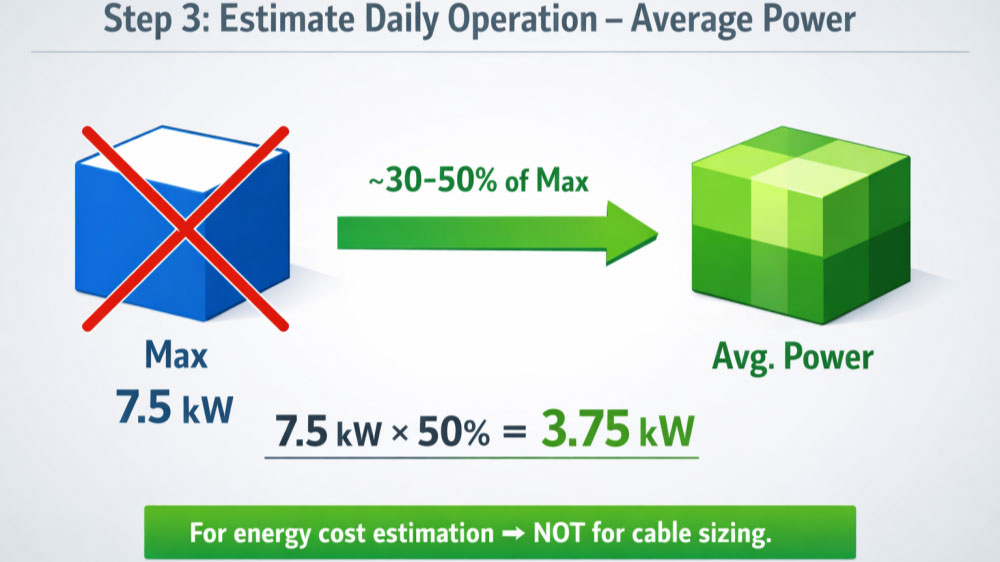
In engineering practice, average power is often estimated as a portion of the maximum screen power.
As a rough reference, some projects estimate video playback power at around 50% of the maximum screen power. This value is not a fixed rule and should not be treated as a constant.
- Example: Average Power Estimation
Using the same 10 m² outdoor LED screen:
- Maximum screen power: 7.5 kW
Estimated average operating power during video playback:
- 7.5 kW × 50% = 3.75 kW
This value represents a typical operating load under normal content and brightness settings.
Average power is mainly used for:
- Estimating daily or monthly electricity consumption
- Comparing energy usage between different LED displays
It should not be used for:
- Power cable selection
- Distribution cabinet sizing
- Electrical protection planning
Step 4: Convert Power to Energy Consumption (kWh)
Power consumption describes the electrical load at a given moment and is measured in kilowatts (kW).
Energy consumption describes how much electricity is used over time and is measured in kilowatt-hours (kWh).
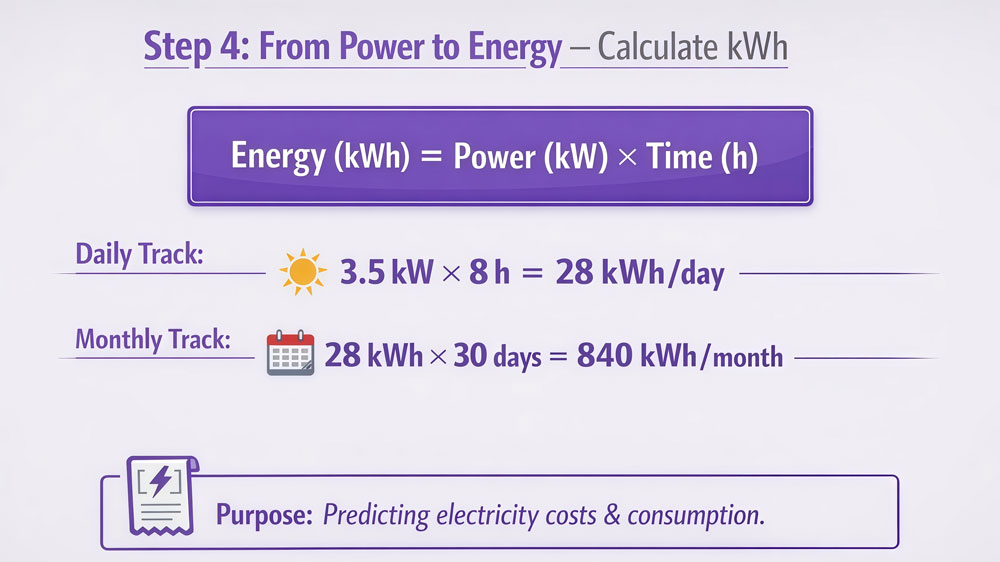
To estimate energy consumption, the average operating power is multiplied by the operating time.
- Basic Formula
- Energy Consumption (kWh) = Average Power (kW) × Operating Time (hours)
- Example 1: Daily Energy Consumption
If an LED display operates at an average power of 3.5 kW and runs for 8 hours per day:
- 3.5 kW × 8 h = 28 kWh per day
This value represents the amount of electricity used in one day.
- Example 2: Monthly Energy Consumption
Using the same screen:
- Daily energy consumption: 28 kWh
- Operating days per month: 30
- 28 kWh × 30 = 840 kWh per month
This result is commonly used to estimate monthly electricity cost.
A Practical Calculation Summary for First-Time Users
If you are calculating LED screen power consumption for the first time, you can follow this simplified process:
- Use the manufacturer’s data to calculate the maximum screen power
- Add reasonable capacity to obtain the total installed system power
- Estimate average power separately for energy and cost evaluation
- Use each value only for its intended purpose
As long as maximum power, installed power, and average power are not mixed, the calculation remains clear and reliable.
3. Using Power Consumption Data to Select Power Cables
Power cable selection is a practical step based directly on power calculation. The purpose is simple: to allow the power system to carry the maximum possible load safely and continuously.
For this reason, cable selection is based on installed system power, not average operating power.
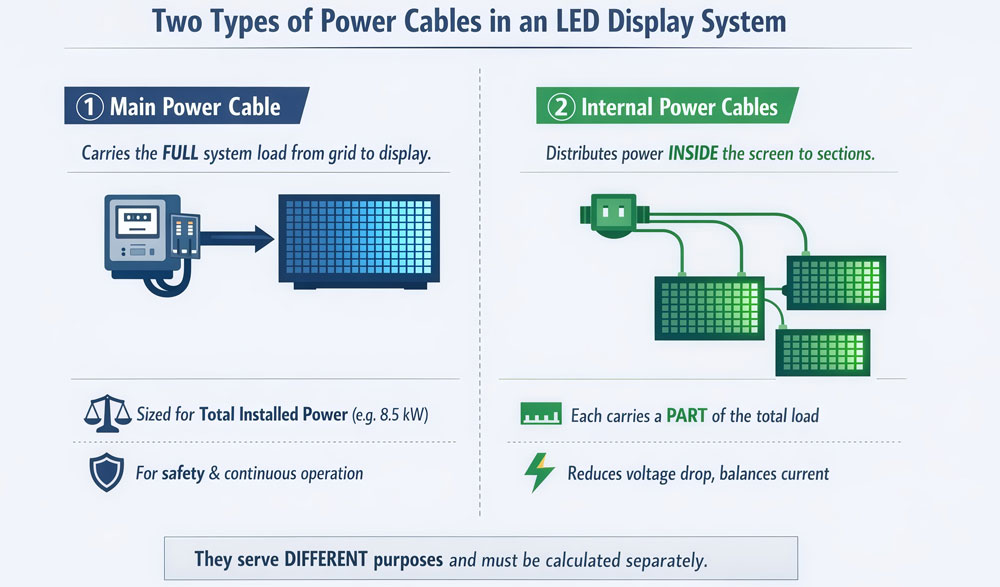
Before selecting cable sizes, it is important to clarify two different types of power cables used in an LED display system:
① Main power cable
The main power cable delivers electricity from the distribution system to the LED display as a whole. It carries the full installed system load and is sized based on the total installed power.
② Internal power cables
Internal power cables distribute power from the system entry point to different screen sections or power supply units. Each cable carries only part of the total load and is used to balance current and reduce voltage drop within the screen.
These two cable types serve different purposes and must be calculated separately.
Step 1: Decide Which Power Value Is Used
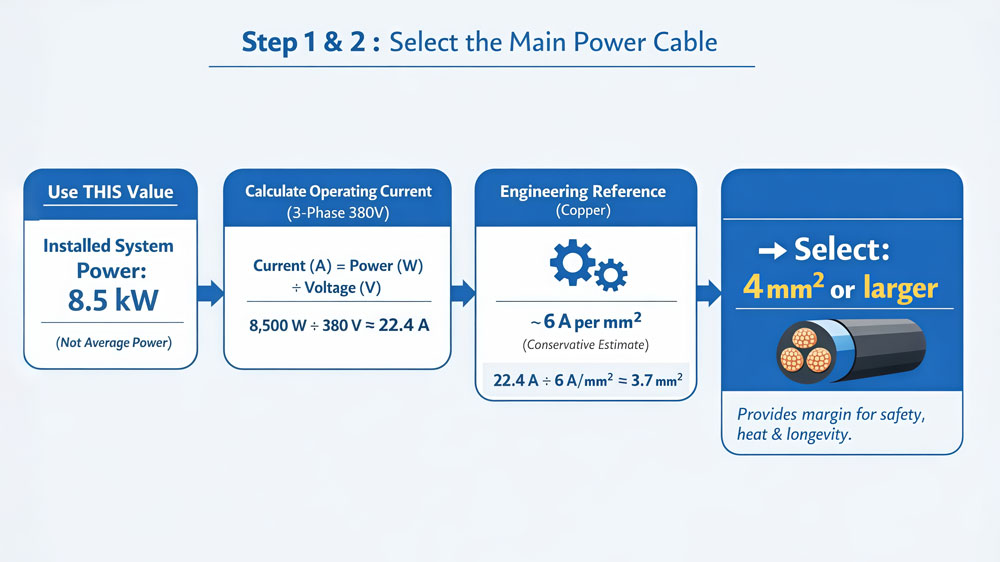
From the previous section, three values have already been defined:
- Maximum screen power: 7.5 kW
- Installed system power: 8.5 kW
- Average operating power: 3.75 kW
Only installed system power is used for cable selection.
Average power reflects daily usage and electricity cost. It does not represent the electrical limit of the system and should not be used for safety-related decisions.
Step 2: Calculate the Operating Current
Assume a three-phase 380 V power supply.
✔ Operating current is estimated as:
- Current (A) = Power (W) ÷ Voltage (V)
- 8,500 W ÷ 380 V ≈ 22.4 A
This value represents the current the main power cable must be able to carry under maximum load conditions.
Step 3: Select the Main Power Cable
In many LED display projects, a conservative engineering reference is used for copper conductors: approximately 6 A per mm²
This value is not a strict rule. It is an experience-based reference that balances safety, heat dissipation, and long-term reliability.
✔ Using this reference:
- Required cross-section = 22.4 A ÷ 6 ≈ 3.7 mm²
✔ Cable size should not be selected at the calculated minimum. The next standard size is chosen.
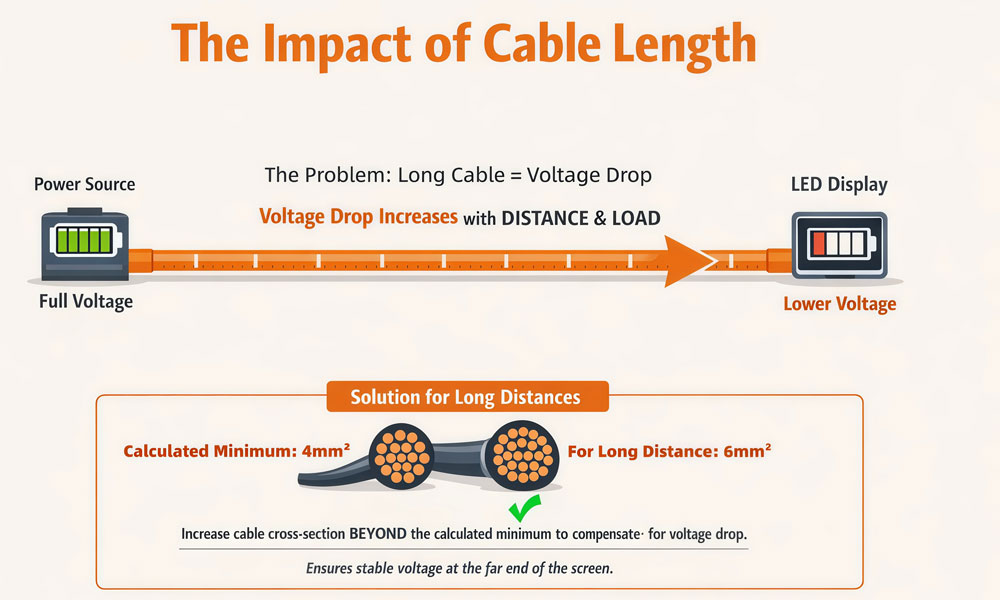
- Main power cable selection: 4 mm² copper cable or larger
This leaves margin for:
- Continuous operation
- Environmental temperature
- Aging of insulation
Step 4: Internal Screen Power Cables
The main power cable supplies the system as a whole.
Internal power cables distribute electricity to different screen sections.
These cables typically use a single-phase 220 V supply.
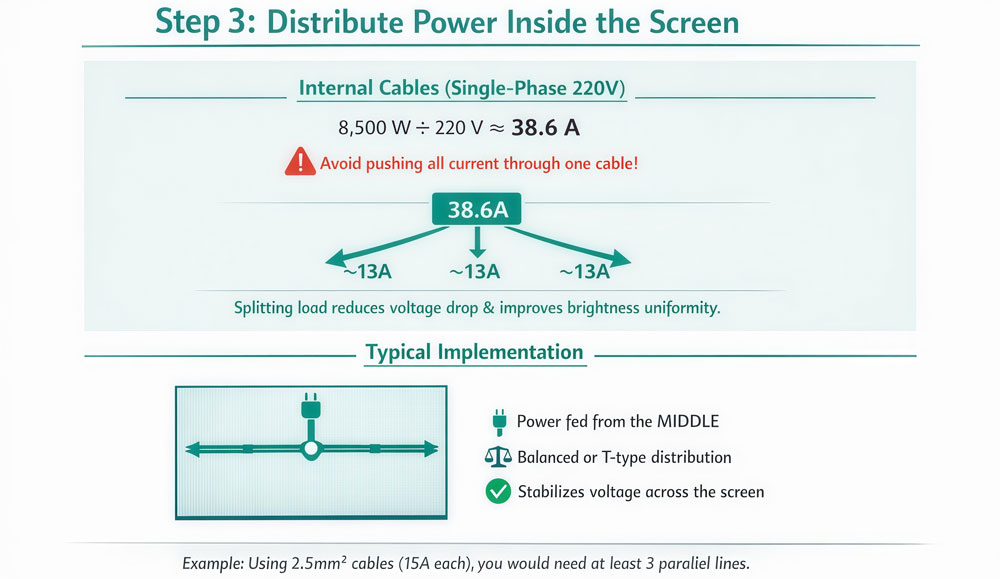
① Using the same installed system power to calculate the current through the cables:
- Basic Formula: I=V÷P (P = power in watts (8,500 W), V = voltage (220 V))
- 8,500 W ÷ 220 V ≈ 38.6 A
② A common choice for internal wiring is 2.5mm² copper cable.
According to standard guidelines, each 2.5mm² copper cable can safely carry about 6 A per mm², so:
- 2.5 × 6 ≈ 15 A
③ Required number of internal power lines:
- Basic Formula: Number of cables=Total current÷Single cable capacity
- 38.6 A ÷ 15 A ≈ 2.6
④ Rounded up:
- 3 internal power cables
Instead of pushing all current through one cable, splitting the load reduces voltage drop and improves brightness consistency.
In practice, power is often fed from the middle of the screen using balanced or T-type distribution to further stabilize voltage.
Step 5: Cable Length and Distance
Cable length directly affects resistance.
As distance increases, voltage drop becomes more noticeable, especially at high load.
If the distance between the distribution cabinet and the LED display is long, cable cross-section should be increased beyond the calculated minimum. It prevents low-voltage issues at the far end of the screen.
Key Takeaway
- Use installed system power for all cable calculations
- Convert power to current before selecting cable size
- Apply conservative current density for copper conductors
- Split internal power lines to reduce voltage drop
- Increase cable size for long distances
In real projects, LED video wall power consumption calculation is only one part of system planning. Screen structure, power distribution design, and installation environment also affect final results.
For a broader overview of LED display design and application scenarios, you can visit LED Screen Cloud Platform.
4. Why LED Display Power Calculations Often Go Wrong?
LED display power calculation problems rarely come from complex formulas. They usually come from mixing different concepts that serve different purposes.
- Confusing Maximum Power with Operating Power
One common issue is treating maximum power as normal operating power.
Maximum screen power describes the electrical limit under extreme conditions. It exists to define safety boundaries, not daily electricity usage.
When this value is used to estimate energy consumption, results appear exaggerated. When it is ignored during electrical design, the system becomes unsafe.
- Using Average Power for Electrical Design
Another frequent cause of error is using average power to size cables and distribution equipment.
Average power reflects how the screen behaves during normal playback. It changes with content, brightness, and schedule.
Electrical components, however, must be designed for the highest possible load. Using average power for cable selection removes the safety margin.
This often leads to:
- Overheated cables
- Voltage drop under peak conditions
- Unstable operation over time
- Skipping System Loss and Auxiliary Equipment
Some calculations stop at screen power and do not account for the rest of the system.
In practice, power supplies, control hardware, and cooling equipment all consume electricity. Power conversion loss is also unavoidable.
When these factors are ignored, the installed power is underestimated. This results in power systems that operate close to their limits, even under normal conditions.
- Assuming a Fixed Percentage for Average Power
Average power is sometimes treated as a fixed ratio of maximum power.
Values such as “50% of maximum power” are used as universal rules. In reality, these values are only rough references.
Content type, brightness settings, and environmental lighting all affect actual load. Treating a reference value as a constant leads to inaccurate energy estimates.
- Ignoring Cable Length and Distribution Layout
Even when cable size is calculated correctly, layout is sometimes overlooked.
Long cable runs increase resistance and voltage drop. Poor internal power distribution concentrates current in a single path.
These issues do not always appear immediately. They often show up as flicker, brightness inconsistency, or long-term reliability problems.
- How to Avoid These Issues
The solution is not more complicated formulas.
It is maintaining clear boundaries between:
- Electrical safety
- System planning
- Energy estimation
Once these boundaries are respected, power calculation becomes predictable and reliable.
5. Conclusion
Understanding LED display power consumption is not about finding a single number. It is about knowing which value is used for which decision.
When maximum power, installed power, and average power are clearly separated, power planning becomes safer, clearer, and more reliable.
If you are planning an LED display project and need support with power planning or system configuration, you are welcome to contact LedInCloud for further discussion.