

Nits vs cd/m2: How LED Display Brightness Is Measured
Nits and cd/m2 are the same unit. One nit equals one candela per square meter. The names come from different worlds: cd/m2 is the formal SI term, while “nits” is the display industry’s shorthand.
Comparing LED display spec sheets can be confusing. Some suppliers list brightness as 5,000 nits. Others write 5,000 cd/m2. So you expect two different units that need converting. Here is the surprise: they are the same thing.
But the confusion rarely stops there, because datasheets also throw candela, lumens, and lux at you. Each of those measures something different. This article walks through all four units in plain language, and ends with the number you actually came for: how many nits your LED display needs.
1. What Is cd/m2?
cd/m2 stands for candela per square meter. It is the official SI unit for luminance — the amount of light a surface emits in a given direction, per unit of area.
Break the name down and it explains itself:
- Candela (cd) measures luminous intensity — how strong the light is in one specific direction.
- Per square meter (/m2) divides that intensity across the surface area.
So a screen rated at 800 cd/m2 emits light with an intensity of 800 candelas from every square meter of its surface, in the direction of the viewer. That is the number your eyes actually respond to when you look at a display.

2. What Is a Nit?
A nit is the same quantity under a friendlier name. The word comes from the Latin nitere, meaning “to shine.” One nit equals one candela per square meter — exactly, with no conversion factor.
The term became popular in consumer electronics. Phone makers, TV brands, and laptop manufacturers found “nits” shorter and easier to say than “candela per square meter,” so it stuck. When a phone is advertised at “2,000 nits peak brightness,” it means 2,000 cd/m2.
In short: cd/m2 is the scientist’s term. Nits is the marketer’s term. The number behind both is identical.
3. cd/m2 vs Nits: Are They the Same?
Yes — completely. 1 nit = 1 cd/m2. A 5,000-nit LED screen and a 5,000 cd/m2 LED screen are equally bright. There is no formula, no multiplier, and no situation where the two values diverge. This is the whole answer to the cd/m2 vs nits debate.
So why do both terms exist? Because the LED display industry sits between two worlds:
- Engineers and test labs use cd/m2. It is the SI standard, and calibration instruments report in it.
- Sales teams and consumer brands use nits. It is easier to say, easier to print, and easier for buyers to remember.
Most professional LED display manufacturers list both. You will see “Brightness: 6,000 nits (6,000 cd/m2)” on the same datasheet. When comparing suppliers, treat the two as interchangeable and focus on the number itself.
4. Candela vs Nits: What's the Real Difference?
Here is where people genuinely get confused. A search for “candela vs nits” looks like the same question as “cd/m2 vs nits,” but it is not. Candela and nits are different units — and knowing why matters when you read a spec sheet.
4.1 Candela measures the source
Candela (cd) is luminous intensity from a source in one direction. It has nothing to do with area. A flashlight rated at 10,000 cd throws a concentrated beam; the rating stays 10,000 cd whether the beam hits a wall one meter away or ten.
4.2 Nits measure the surface
Nits (cd/m2) measure luminance — intensity spread across a surface. The same 10,000 cd spread over a 10 m2 LED screen gives 1,000 nits. Packed into a 1 m2 screen, it gives 10,000 nits.
So the rule is simple. Candela describes the source. Nits describe the surface. That is also why display specifications never use plain candela: a 100 m2 billboard and a 2 m2 retail screen could emit the same total candela while looking completely different in brightness. Dividing by area — which is what nits does — is what makes the number meaningful for a screen you actually look at.
5. Lumens vs Lux vs Nits: Quick Comparison
So where do lumens and lux fit in? People often search “lumens vs nits” expecting one to be a converted version of the other. In fact, all four units — candela, nits, lumens, and lux — describe light, but each answers a different question:

| Unit | Measures | The Question It Answers | Typical Use |
| Lumen (lm) | Luminous flux — total light output in all directions | How much light does the source produce in total? | Light bulbs, projectors |
| Lux (lx) | Illuminance — light arriving on a surface (1 lx = 1 lm/m2) | How much light lands on this surface? | Room lighting, workplace lighting |
| Candela (cd) | Luminous intensity in one direction | How strong is the light in this direction? | Flashlights, spotlights, beam specs |
| Nit (cd/m2) | Luminance — light emitted per unit of surface area | How bright does this screen look to the viewer? | Displays: phones, TVs, LED screens |
Now the pair people mix up most: lux vs nits. The difference is direction. Lux counts light arriving at a surface. Nits count light leaving a surface toward your eyes.
5.1 Lux vs nits: one surface, two numbers
Picture an outdoor billboard at noon. Sunlight hits the screen face with an illuminance of maybe 80,000 lux — that is the “arriving” number. To stay readable, the screen pushes back with its own light: 5,500 nits — the “leaving” number. Two different measurements, one surface.
That is also why the two units never swap. You cannot convert lux into nits without knowing more about the surface, because one describes what the environment delivers and the other describes what the display emits.
5.2 Lux vs lumens: close relatives
This pair is easier. One lux is one lumen spread over one square meter. Lumens measure everything a bulb gives out; lux measures how much of it actually reaches your desk. So a 1,600-lumen bulb feels bright in a small study but dim in a large hall — same lumens, different lux.
For display work, keep this in mind: lumens and lux belong to the lighting world. Neither belongs on an LED display datasheet — brightness there is always nits or cd/m2.
6. How to Convert cd/m2 to Nits?
You will rarely need a formula for this. Since cd/m2 and nits are the same unit, converting between them is just a rename:
- 500 cd/m2 = 500 nits
- 5,500 cd/m2 = 5,500 nits
- 10,000 nits = 10,000 cd/m2
The only conversion worth knowing is candela to nits — and you only need it if a supplier quotes brightness in plain candela, without the “per square meter.” In that case, just divide by the screen area:
Brightness (nits) = candela (cd) ÷ screen area (m2)
Real example: a small LED screen emitting 3,000 cd over 2 m2 of surface runs at 1,500 nits. That is the entire math. If a datasheet already states nits or cd/m2 — as professional LED display datasheets normally do — you can skip the calculation and compare numbers directly.
7. How Many Nits Do LED Displays Need?
Now for the practical question. LED Display Brightness requirements depend almost entirely on ambient light. The brighter the environment, the more nits the screen needs to compete. Here are the ranges the industry works with:

| Application | Typical Brightness | Example |
| Indoor LED poster / retail display | 600–1,200 nits | LED poster screens (e.g., LC70 class) |
| Indoor LED screen (conference, control room) | 800–1,500 nits | Fine-pitch fixed installation |
| Semi-outdoor / storefront | 2,000–3,500 nits | Window-facing displays |
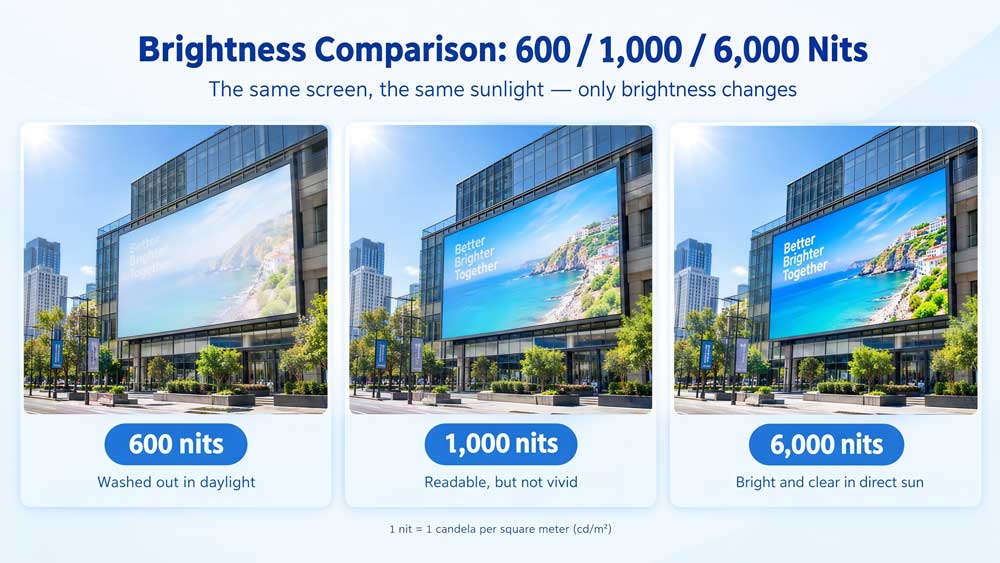
| Outdoor — standard | 4,500–7,000 nits | Outdoor fixed screens (e.g., OF1000C ≥5,500 nits) |
| Outdoor — direct sunlight | 8,000–10,000+ nits | High-brightness outdoor series (e.g., ES1000 high-brightness option) |
7.1 Indoor LED screens
Indoor venues have controlled lighting, so moderate brightness works best. Conference rooms, showrooms, and control rooms typically run 600–1,500 nits. Push much beyond that and the screen starts to glare — viewers squint, colors wash out, and eye fatigue sets in during long sessions.

7.2 Outdoor LED screens
Daylight is the enemy. Direct sunlight can exceed 10,000 times the illuminance of a typical office, so outdoor screens need roughly 4,500–10,000 nits. For a shaded or north-facing installation, 4,500–6,000 nits is usually enough. For a rooftop billboard in full sun, spec 8,000–10,000 nits.
Many outdoor LED screen series ship in two brightness grades. A standard build delivers around 5,500–7,000 nits, while a high-brightness build reaches 8,000–10,000 nits for the most exposed locations.
Brightness is only half the story, though. The number on the datasheet is not always the number you get on installation day.

7.3 Peak vs sustained brightness — read the spec carefully
Here is a trap that unit knowledge alone will not save you from. Some manufacturers quote peak brightness: the maximum a screen can hit briefly. Others quote sustained brightness: what the screen holds continuously at normal operating temperature. Both are “real” numbers, but only one reflects daily operation.
A spec that says 8,000 nits peak may sustain only 6,000. Before you compare quotes, ask suppliers three questions:
- Is this figure peak or sustained brightness?
- Was it measured after white-balance calibration, at the color temperature I will actually use?
- What is the rated brightness after X hours of operation?
One more myth to drop: higher nits do not automatically mean a better screen. Indoor screens running excessively bright age faster, consume more power, and lose color uniformity sooner. The right nit rating is the one matched to your environment — not the biggest number on the page.
8. FAQ
Q1. Is cd/m2 the same as nits?
Yes. One nit equals one candela per square meter. The two terms describe the identical unit of luminance, and the values can be used interchangeably on any datasheet.
Q2. How many nits does an outdoor LED screen need?
At least 4,500–6,000 nits for typical outdoor installations, and 8,000–10,000+ nits for locations with direct sunlight. The exact figure depends on screen orientation, local climate, and viewing distance.
Q3. What's the difference between nits, lumens, and lux?
Lumens measure total light output from a source. Lux measures light landing on a surface. Nits (cd/m2) measure how bright a surface — such as a screen — appears to the viewer. For displays, nits is the unit that matters.
Q4. Does higher nits mean better quality?
No. Brightness beyond what your environment needs wastes power, accelerates LED aging, and can cause glare. Match the nit rating to the installation site instead of chasing the highest number.
Q5. Can LED display brightness adjust automatically?
Most professional LED screens support brightness scheduling, and many support ambient light sensors that dim the screen at night and boost it in daylight. Confirm with your supplier what is included in the quote.
9. Conclusion
Let’s close the loop on cd/m2 vs nits: one unit, two names. A spec sheet reading 6,000 cd/m2 describes exactly the same screen as one reading 6,000 nits.
The other pairs differ for real:
- Candela vs nits: source strength in one direction versus surface brightness.
- Lux vs lumens: light landing on a surface versus total light output — neither belongs on a display datasheet.
- Nits vs lumens, or lux vs nits? Same rule: only nits (cd/m2) tell you how bright a screen actually looks.
Next time you see “candela (cd/m2) vs nits” in a headline, you know the ending already. The smarter questions are how many nits your site needs and whether the figure is peak or sustained. Get those right, and the label stops mattering.
Still deciding what brightness your project needs? Contact LedInCloud – LED Screen Cloud Platform for a recommendation based on your installation environment.