
Huidu LED: Products, Specs, and How to Choose the Right Controller
Specializing in innovative solutions such as the Huidu LED controller, Huidu LED cloud platform, and Huidu LED software, Huidu Technology empowers industries ranging from advertising and entertainment to smart cities. This article delves into Huidu’s product system, highlighting six core categories with models, technical specifications, and applications.
1. Introduction
Since its establishment in 2009, Shenzhen Huidu Technology has cemented its position as a global leader in LED display control systems and LCD Android motherboards. Recognized as a national high-tech enterprise, Huidu LED specializes in delivering cutting-edge solutions that redefine visual communication across industries—from dynamic advertising screens to immersive smart city installations. With a relentless focus on innovation, the company has pioneered technologies such as the Huidu LED control card and Huidu LED cloud platform, setting new benchmarks in stability, customization, and user-centric design.
2. Huidu LED Product Portfolio
Shenzhen Huidu Technology builds one of the widest control product ranges in the LED display industry. Its portfolio covers asynchronous players for offline signage, synchronous systems for live events, single-color control cards, video processors, LCD Android boards, and a full software suite. The table below sums up the lineup at a glance, so you can shortlist a model before reading the details.
| Model | Category | Load / Capacity | Connectivity | Best For |
| HD-A6L | Asynchronous player | 2.6M pixels, 4K (H.265) decoding | Dual-band Wi-Fi, 4 gigabit outputs, USB 3.0 | Standalone ad screens |
| HD-A7 | Asynchronous/synchronous controller | 5.2M pixels (sync) | 5×HDMI + 1×DP 4K@60Hz, optional 4G/5G | Large standalone walls |
| HD-T901 | Synchronous sending card | 1.3M pixels | DVI, 2 gigabit ports, USB | Stages and concerts |
| HD-T08 | 4K synchronous sending box | 5.2M pixels | HDMI 2.0/DP 1.4, 8 gigabit outputs | Extra-large video walls |
| HD-W04 | Single-color control card | 768×64 pixels | Wi-Fi | Menu boards, price signs |
| HD-W60 | Single/dual-color Wi-Fi card | 512×32 pixels (dual color) | Wi-Fi, U-disk | Outdoor text billboards |
| HD-VP620A | All-in-one video processor | 3.9M pixels | HDMI/DP/DVI/VGA, 6 gigabit ports | Command centers |
| HD-VP210S | All-in-one controller | 1.3M pixels | 2×HDMI in, 2 gigabit outputs, U-disk | Meeting rooms |
| HD-3399F-BOX | LCD Android board | 4K H.265 decode | HDMI IN/OUT, RJ45, Wi-Fi | Interactive kiosks |
| HD-528M | LCD mainboard | 1080p via LVDS | PoE, dual USB | Industrial panels |
Every model above works with the Huidu LED controller system and its software tools. The sections below walk through each category and explain which situation each product fits.
2.1 Asynchronous Full-Color Control Systems
Asynchronous systems store content on the player itself. The screen keeps playing even after you power off the control computer, which makes them the default choice for standalone digital signage and advertising displays.
2.1.1 Huidu A6L Multimedia Player
Huidu A6L is a compact multimedia player built for unattended screens. It drives up to 2.6 million pixels through four gigabit output ports and decodes 4K video (H.265), so a single box can run a large storefront screen with room to spare. HDMI splicing supports multi-screen setups, and it switches between synchronous and asynchronous playback. Dual-band Wi-Fi (2.4GHz/5GHz) connects it to the LedArt APP for phone control, and 16GB of onboard storage expands through USB 3.0. The Xiaohui Cloud platform adds remote cluster management, with optional 4G/5G for sites without wired internet.
Best for: shopping mall signage, transportation hub displays, and smart city billboards.

2.1.2 Huidu A7 4K Super Controller
The A7 is the stronger sibling in this category. It drives up to 5.2 million pixels in synchronous mode (5.16 million in asynchronous mode) and plays 1-channel 4K video or 4-channel 1080P windows at once. Five HDMI inputs and one DP input accept 4K@60Hz sources, and a built-in Android 10 system runs third-party apps with voice control support. An optional 4G/5G module connects it to the Huidu cloud for cluster management across sites.
Best for: large-scale exhibitions, stadium displays, and broadcast studios that need both offline playlists and live switching.

2.2 Synchronous Control Systems
Synchronous systems mirror your computer’s screen in real time. Whatever plays on the PC shows on the LED wall at the same moment, which is why live events, concerts, and broadcast studios rely on them.
2.2.1 Huidu T901 Sending Card
The T901 drives up to 1.3 million pixels (max width 3840 or max height 2048) with 65536 grayscale levels for smooth, natural images. It cascades with R50X receiving cards through dual gigabit Ethernet ports and takes DVI input from the control computer. Widths beyond 1920 pixels pair with a video processor. Setup and calibration run through HDPlayer and the HDSet debugging tool.
Best for: indoor and outdoor stage screens and concert walls.

2.2.2 Huidu T08 4K Synchronous Sending Box
The T08 is the flagship of this category. It delivers 5.2 million pixels through eight gigabit Ethernet outputs—each port carrying up to 650,000 pixels—and accepts 4096×2160@60Hz input over HDMI 2.0 or DP 1.4. The maximum width or height reaches 8192 pixels, which covers ultra-long and ultra-large screen builds. One-key black and freeze, seamless splicing of multiple units, and an HDMI OUT preview port make live operation straightforward.
Best for: ultra-large video walls, hotel and mall installations, and studios that need synchronized playback.

2.3 Single-Color Control Cards
Not every screen needs video. For text, prices, and simple graphics, single-color cards cost far less and stay online for years with almost no maintenance.
2.3.1 Huidu W04 Wi-Fi Control Card
The W04 controls single-color displays up to 768×64 pixels (1024×48 and 1536×32 also supported). It connects over Wi-Fi—your phone or laptop joins the card’s hotspot and updates content in about a minute. It also works with temperature, humidity, and brightness sensors, which is useful for factory dashboards and outdoor signs that report conditions. Certified to CE, FCC, and RoHS.
Best for: retail menu boards, door lintel screens, and store signs.

2.3.2 Huidu W60 Wireless Control Card
The W60 adds dual-color support (512×32 pixels) and 4M of flash storage that holds up to 1,000 scheduled programs offline. You manage it through the LedArt APP over the card’s Wi-Fi hotspot, or update content from a U-disk. Brightness adjusts manually, automatically, or by time schedule.
Best for: door headers, store signs, and outdoor text billboards.

2.4 Huidu Video Processors
Video processors sit between your sources and the LED wall. They scale, switch, and manage multiple inputs, so a command center or conference room can show several signals without extra hardware.
2.4.1 Huidu VP620 Two-in-One Processor
The VP620 combines a video processor and 6-way gigabit output in one box. It handles 3.9 million pixels (max width 8000, max height 4000) and accepts 4096×2160@60Hz input over HDMI, DP, DVI, VGA, or an optional SDI port. Dual-window display with PIP and POP, eight saveable scene presets, and Wi-Fi app control cover most live switching needs.
Best for: hotels, conference rooms, and command centers.

2.4.2 Huidu HD VP210S All-in-One Processor
The VP210S is a three-in-one unit: video processor, 2-way gigabit output, and U-disk playback. It drives up to 1.3 million pixels (max width 3840 or max height 2500) and switches between two HDMI inputs, with U-disk video playback up to 1920×1080@30Hz. One-touch brightness adjustment and a key-lock function suit unattended rooms, and all of it fits a 1U chassis.
Best for: conference rooms, exhibitions, and small live setups.

2.5 LCD Android Controllers
Huidu also builds Android and Linux boards for commercial LCD screens—the displays you see in kiosks, elevators, and office lobbies.
2.5.1 HD-3399F-BOX Android Controller
This board runs Android 11 on a Rockchip RK3399 six-core CPU, with configuration options up to 4GB RAM and 64GB storage. It decodes 4K H.265 video and offers one HDMI IN (up to 1080p) plus one HDMI OUT (up to 4K), alongside LVDS/EDP panel interfaces for integrators.
Best for: interactive kiosks and digital signage networks.

2.5.2 HD-528M LCD Mainboard
The HD-528M runs Linux 5.4 on an Allwinner R528 chipset. It drives 1080p panels over LVDS, supports PoE power, and offers a modular design for IoT sensor integration—handy when the board needs to talk to other equipment.
Best for: industrial control panels and smart office displays.

2.6 Huidu LED Software Free Download
Huidu LED controller software suite simplifies content creation, management, and optimization, such as: Huidu LED Cloud, Huidu LED Art.
2.6.1 Huidu HDPlayer
HDPlayer is the PC playback and control software for Huidu’s full-color systems. It handles program editing, screen configuration, and network setup for A-series players and T-series sending cards—one tool covers the whole workflow from install to daily playback.
2.6.2 HD2018 LED Software Huidu
HD2018 is the configuration tool for Huidu’s single-color and dual-color control cards (the W04, for example). It covers offline scheduling, brightness calibration, and temperature monitoring, and comes with lifetime free updates. Newer cards like the W60 also work with HD2020 (HDSign) and the LedArt APP.
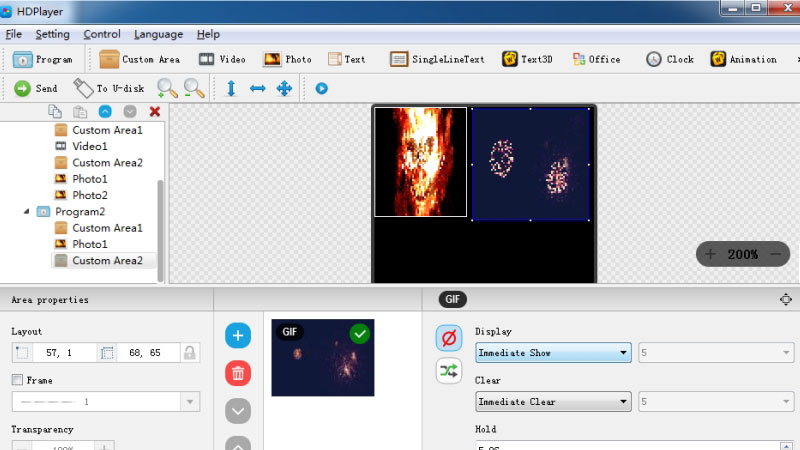

Click here to free downolad:
2.7 How to Choose a Huidu LED Controller?
Huidu’s catalog is much bigger than any single list. Beyond the models above, the company offers dozens of control cards, receiving cards, and processors in different pixel capacities, port layouts, and price points. Choosing the right one comes down to three questions. Answer them in order and the shortlist usually narrows to one or two models.
Question 1: Does the Screen Need Live Content?
This is the biggest split in the lineup. If your screen plays pre-made playlists—a store sign, a billboard, a menu board—choose an asynchronous controller like the A6L or A7. The screen runs on its own, and you push new content over Wi-Fi or the cloud. If the screen must mirror a live source—a stage feed, a camera, a sports broadcast—choose a synchronous system like the T901 or T08.
Question 2: How Many Pixels Does Your Screen Have?
Every controller has a maximum load, counted in pixels rather than screen size. Multiply your panel’s width and height in pixels—for example, a 960×320 sign is 307,200 pixels—and pick a controller with headroom above that number. A T901 covers up to 1.3 million pixels, the A6L up to 2.6 million, while the A7 and T08 handle 5.2 million pixels. Always leave 20–30% headroom so the system stays smooth under full white playback.
Question 3: Who Manages the Screen Day to Day?
If a non-technical staff member updates content, choose models that pair with the LedArt APP or the Huidu XiaoHui Cloud Platform, which recognizes devices automatically without manual IP setup. If a dedicated technician runs the system, the full HDPlayer toolset gives deeper control over calibration and scheduling.

Quick Recommendations by Scenario
| Scenario | Recommended Model | Why |
| Retail menu board or price sign | HD-W04 | Low cost, phone updates, sensor support |
| Outdoor text billboard | HD-W60 | Wi-Fi control, offline scheduling for 1,000+ programs |
| Standalone ad screen, single site | HD-A6L | 2.6M pixels, 4K playback, cloud management |
| Large standalone wall | HD-A7 | 5.2M pixels, dual-mode operation |
| Stage or concert screen | HD-T901 | Real-time sync, 65536 grayscale |
| Ultra-large video wall | HD-T08 | 8 gigabit outputs, 8192 pixels max width/height |
| Command center or control room | HD-VP620 | 3.9M pixels, multi-input switching, PIP/POP |
| Meeting room display | HD-VP210S | Compact 1U, U-disk playback |
3. Huidu LED Solutions and Applications
Huidu’s innovative technologies translate into versatile solutions tailored to modern display needs:
(1) Distributed Control Solutions
Ideal for command centers and smart venues, these systems unify management of multi-screen setups. The huidu led cloud platform enables centralized control, allowing operators to schedule content, adjust brightness, and troubleshoot displays across locations in real time.
(2) LCD Shaped Splicing Solutions
Breaking free from traditional rectangular displays, Huidu supports irregular configurations like curves, circles, or 3D structures.
(3) Smart LED Pole Screen Solutions
Integrated into smart city infrastructures, these displays deliver real-time public information (e.g., traffic updates, weather alerts) via energy-efficient huidu led control cards.
(4) Internet Cloud Solutions
The huidu led software free download system allows users to manage global LED networks remotely. From content updates to firmware upgrades, the cloud-based platform streamlines operations while reducing on-site maintenance costs.
4. Huidu LED Technological Innovations
Shenzhen Huidu Technology has consistently driven advancements in LED display control systems through groundbreaking technological innovations.
4.1 Pioneering Achievements
Huidu released the world’s first USB-powered single and dual-color control cards. Before that, setting up a simple text screen meant messy wiring and complex configuration. With these cards, you plug in, load your program, and the screen runs—no engineering background needed.
Cloud control is the second big one. Huidu built one of the earliest commercial cloud platforms for LED displays, so users can update content and check screen status from anywhere. Its Huidu XiaoHui Cloud Platform went a step further: devices connect to the cloud automatically, with no manual IP setup. On a site with dozens of screens, that saves hours of configuration work.
Huidu also takes security seriously. The company earned Level 3 certification for internet information security protection, which matters when your screens are managed over the internet.
4.2 Intellectual Property Leadership
Huidu holds more than 70 patents and intellectual property rights. These cover both hardware—like the multi-protocol designs inside its control cards—and software, including the HD2018 and LedArt tools for editing and syncing content across devices. For buyers, this means the products are built on in-house technology, not patched-together third-party parts.
5. Conclusion
Huidu LED has redefined the standards of LED and LCD display control through relentless innovation and customer-centric solutions. From pioneering huidu led control cards to shaping smart city infrastructures with huidu led cloud platforms, the company continues to lead the industry in reliability, scalability, and technological sophistication.
Whether you’re managing a small retail display or a global network of screens, Huidu’s hardware and software offerings in LedInCloud-LED Screen Cloud Platform provide the tools to captivate audiences and streamline operations.