
Picking the Right Stadium LED Screen: A Practical Breakdown
Stadium LED screen technology has changed the game for fans, sponsors, and broadcasters. From the giant screen hanging over the field to the perimeter LED display running along the sideline, these systems do a lot more than show the score now.
This guide walks through what a stadium LED display actually is. It covers the main types you’ll find in a modern venue. It also breaks down what drives the price up or down. And it helps you pick the right screen for your stadium. So you’re not stuck guessing between a football stadium LED display and a general-purpose LED screen stadium setup.
1. What Is a Stadium LED Screen?
A stadium LED screen is a large digital display built from LED panels. Venues install it to show scores, replays, and advertising. It can sit at the center of the field as a main screen. It can wrap around the pitch as a perimeter LED display. Or it can line the stands as a scoreboard.
A stadium LED display isn’t like a single LCD panel. It’s modular. Cabinets bolt together side by side. That means the screen can be almost any size or shape. A stadium can run a giant center-hung screen and a 300-meter stadium perimeter LED display around the pitch at the same time. Both use the same basic panel technology.
LED panels took over from old scoreboards and projection screens. The reason is simple. They stay bright and sharp outdoors, even in direct sunlight. Projectors can’t match that. So a football stadium LED display isn’t just a nice extra anymore. It’s part of how the venue runs game day. It shows the score. It sells ad space to sponsors. It keeps fans locked into the action.
2. Key Features
A stadium LED display has to handle things a regular screen never sees. Rain, direct sun, a ball hitting the panel mid-game. So the features aren’t just extras. They’re what makes the screen survive a full season.

✔ Anti-glare surface
Bright stadium lighting and direct sunlight both wash out a regular screen. A good sport LED display uses a low-reflection panel coating. It keeps the image readable from any seat, even under floodlights.
✔ Modular build
Every LED display for sports is built from small cabinets, not one giant panel. Venues can size the screen to fit the space, and swap out a single cabinet instead of replacing the whole unit if something breaks.
✔ Flexible mounting
A sports LED screen doesn’t have to hang. It can mount along the perimeter, hang from a center rig, or stack against a wall. Same panel technology, different layout depending on where the venue needs it.
✔ Dual signal backup
This one matters more than it sounds. Two independent control sources run at once. If one drops out mid-match, the other takes over instantly. No blackout, no dead screen during a live broadcast.
✔ High refresh rate
Fast-moving action needs a screen that keeps up. A refresh rate in the thousands of Hz cuts down flicker, so the picture stays sharp during live play, not just in still shots.
✔ Weatherproofing
Outdoor venues take rain, dust, and temperature swings all year. An IP65-rated stadium LED screen keeps working through all of it, without the image degrading over time.
✔ Front-access maintenance
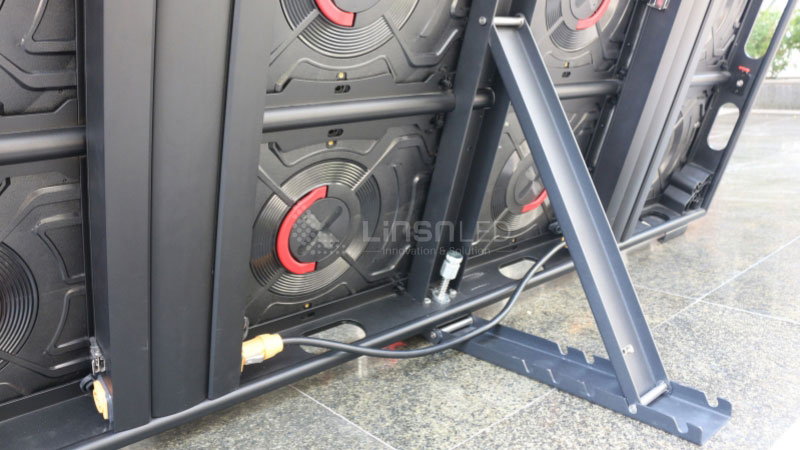
Techs can swap a module from the front of the panel, not the back. That means faster repairs, and no need to tear into the structure behind the screen to fix a single cabinet.
✔ Lower power draw
Newer LED display sport models use less energy than older generations for the same brightness. That cuts the venue’s running cost over years of daily use, not just game days.
✔ Remote management
Operators don’t need to touch the screen to change what’s on it. Content, ads, and scores all update over the network, often from a laptop in the control room.
✔ Custom configuration
Pixel pitch, cabinet size, and mounting style can all be matched to the venue. A small indoor arena and a 60,000-seat stadium need different specs, and a good supplier builds to that difference instead of selling one fixed setup.
✔ Sports LED Displays vs. Traditional LED Screens
A traditional LED screen or LCD panel struggles with the exact conditions a stadium throws at it — direct sunlight, wide viewing angles, constant outdoor exposure. Sports-specific models like the MA960 close that gap with a brighter, more uniform panel built for exactly this environment. The difference shows up clearest side by side:
3. Core Functions
A stadium LED screen does more than sit there and look impressive. Every function it runs ties back to how the venue operates on game day.

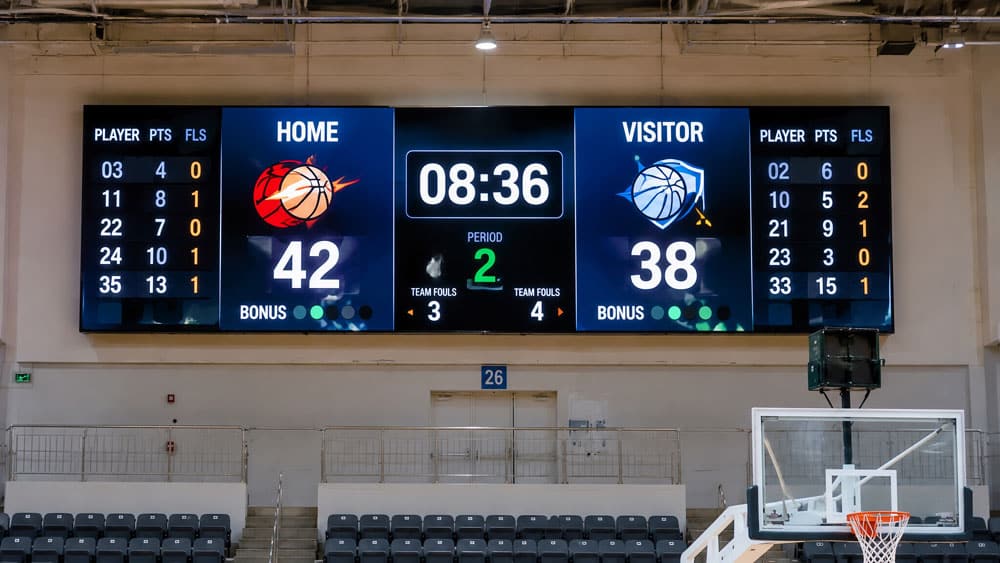
Scoring and stats: This is the core job. The screen pulls live data straight from the scoring system, so fans see the score, the clock, and player stats update in real time, without anyone manually keying it in.
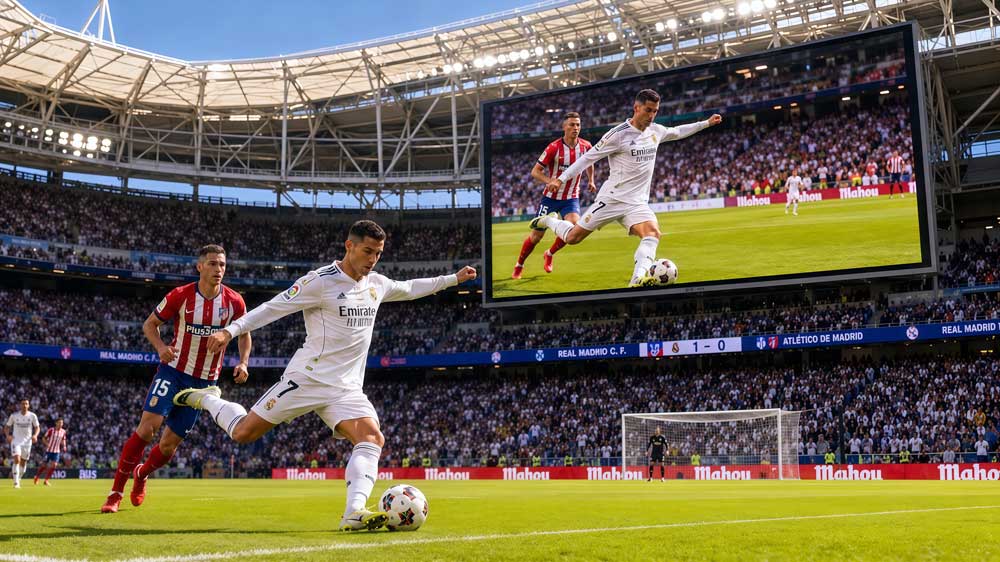
Instant replay: A missed goal or a controversial call gets replayed in seconds. Broadcast feeds or on-site cameras push straight to the screen, and the crowd sees the moment again almost as fast as it happened.
Advertising and sponsorship: A sports LED display doubles as revenue. Sponsors buy rotating ad slots on the perimeter LED display or the main screen. Each slot gets guaranteed airtime during the match, which is easier to sell and track than a static billboard.
Crowd engagement: Fan cams, contests, countdowns, walk-out graphics. All of that runs through the same screen system, and it’s a big part of what keeps the atmosphere up during breaks in play.
Wayfinding and safety messaging: Beyond entertainment, the screen carries exit directions, weather alerts, or emergency instructions when needed. That’s a function venues don’t advertise much, but it matters when something goes wrong.
Broadcast enhancement: For televised events, the LED display for sports becomes part of the shot. Camera operators can frame the screen directly into wide shots and replays, so sponsor branding gets airtime beyond just the people in the stadium.
4. Main Types of Stadium LED Display
A full stadium setup rarely runs on one type of screen. It runs several, each built for a different spot and a different job.
4.1 Stadium Perimeter LED Display
This is the strip that runs along the edge of the field, at ground level. A stadium perimeter LED display takes hits from stray balls and players, so it’s built low, rugged, and wide — more a long ribbon than a single screen. A football stadium perimeter LED screen display often runs the full length of the sideline, and some setups wrap around the entire pitch. Most are outdoor perimeter LED display units by default, rated for rain and heat swings since there’s rarely a roof over the pitch to shield them.

4.2 Center-Hung or Main Video Screen
This is the big one, usually suspended above the field or mounted at one end. Some venues run it as a four-sided cube for a full 360-degree view from any seat, especially in basketball arenas. It’s the screen fans look to for replays, close-ups, and the main broadcast feed during breaks in play.

4.3 Scoreboard LED Display
Smaller and more fixed than the main screen, this one sticks to scores, time, and stats. Some venues fold it into the center-hung screen. Others keep it separate, running as its own dedicated unit.
4.4 Fascia or Ribbon Board
Mounted along the upper deck or roofline, this type runs a long, narrow strip of content — usually ads, sponsor logos, or crowd graphics. It’s less about detail and more about a wide sweep of color and motion that’s visible from every seat.

4.5 Concourse and Wayfinding Screens
Not every screen faces the pitch. Smaller displays in walkways, concession areas, and entry gates handle directions, menus, and announcements. They see less traffic than the main screens, but they keep the venue running smoothly once fans step away from their seats.
4.6 Mobile or Rental LED Screen
Not every event needs a permanent install. Some venues bring in a temporary stadium LED display for a one-off match or tournament, then break it down and move it to the next location.
Picking between these isn’t about which one is “better.” A full stadium setup usually runs several types at once, each covering a different part of the game-day experience.
5. How to Choose the Right LED Display for Sports?
Picking a stadium LED screen comes down to a handful of decisions. Get these right, and the screen fits the venue. Get them wrong, and you end up with a picture that’s blurry from the back row or a system that can’t survive its first rainy season.
5.1 Match Pixel Pitch to Viewing Distance
Pixel pitch is the distance between LED dots, and it decides how close someone can stand before the image looks blurry instead of sharp. The rule is simple: the farther your audience sits, the wider the pitch can be.

| Pixel Pitch | Recommended Viewing Distance | Typical Application |
| P4 | 4 – 20 meters | Indoor arenas, basketball courts |
| P5 | 5 – 25 meters | Indoor stadiums, futsal courts |
| P6 | 6 – 30 meters | Outdoor training fields, community sports centers |
| P8 | 8 – 50 meters | Mid-size outdoor stadiums, scoreboards |
| P10 | 10 – 100 meters | Large stadium perimeters, grandstands |
| P16 | 15 – 150 meters | Very large venues, remote viewing stands |
5.2 Check Brightness for the Environment
Indoor and outdoor venues need very different brightness levels.

| Environment | Recommended Brightness | Why |
| Indoor arena | 800 – 1,500 nits | Enough clarity without overwhelming a room that isn’t fighting direct sun |
| Outdoor stadium | 4,500 – 6,500 nits | Needed to stay visible against daylight and glare |
More isn’t always better, though. Too much brightness at night can wash out the picture just as badly as too little does in daylight, so the right level also depends on adjustable dimming, not just the peak number on a spec sheet.
5.3 Confirm the Refresh Rate for Live Action
If the venue plans to show instant replay or live broadcast feeds, refresh rate matters more than most buyers expect. A low refresh rate shows up as flicker on camera, even if it looks fine to the naked eye.
| Use Case | Minimum Refresh Rate |
| General display, no broadcast | 1,920 Hz |
| Live broadcast, instant replay | 2,880 Hz or higher |
5.4 Match the Weatherproofing to the Location
| Location | Recommended IP Rating |
| Outdoor stadium | IP65 |
| Indoor arena | IP43 |
An outdoor stadium LED display needs a weatherproof rating, full stop. IP65 protects against rain, dust, and temperature swings. Indoor venues can use a lower rating like IP43, since they’re not fighting the same conditions. Skipping this step to save money upfront is one of the more common mistakes venues make, and it shows up fast once the screen sits through its first storm.
5.5 Plan the Installation Method
Stadium screens mount in a few different ways: floor-standing along the perimeter, suspended from a rig, wall-mounted, or built into the structure itself. The right method depends on where the screen sits and what the venue’s structure can support. Large suspended screens need a serious look at wind load and structural capacity before installation, not after.
5.6 Weigh Upfront Cost Against Long-Term Value
Budget always plays a role, and it’s worth thinking about beyond the initial price tag. A cheaper screen with a lower refresh rate or a weaker weatherproof rating can cost more over time, once repairs and early replacement enter the picture. We’ll break down real cost ranges in the next section.
6. Stadium LED Screen Cost
Price is the question every buyer asks first, and it’s fair — a stadium LED display is a real investment. There’s no fixed number that works for every venue, since pixel pitch, size, and installation method all move the price in different directions. Rather than throw out a range that may not match your setup, here’s what actually decides your final cost.
6.1 What Drives the Price Up or Down
Pixel pitch: A tighter pixel pitch packs in more LEDs per panel, which raises the cost. Wider pitches, built for long viewing distances, cost less per square meter.
Size and total area: Bigger screens cost more in total, but the price per square meter often drops slightly at scale, since fixed costs like the control system get spread across more panels.
Installation complexity: A floor-standing perimeter display is cheaper to install than a suspended center-hung screen, which needs structural engineering and wind-load calculations before it goes up.
Maintenance access: Front-service panels cost a bit more upfront than rear-service ones, but they save money over years of use by cutting labor time on every repair.
Indoor vs. outdoor rating: An IP65-rated outdoor panel costs more than an indoor-only version with a lower protection rating, since it needs sealed housing and weatherproof components.
Structure and extras: Steel support, cabling, and the control system all add to the panel price, and how much they add depends heavily on the venue itself.
6.2 Get an Exact Number for Your Venue
These factors move the price in different directions depending on your venue, so a general number wouldn’t tell you much anyway. The fastest way to get something useful is to run your actual specs.
That’s what price calculator of LED Screen Cloud Platform is for. Enter the width and height you’re planning, and it works out a budget estimate right away, no waiting on a sales call to get a ballpark. If you want a full quote with installation and structural costs included, register LedInCloud and our team follows up directly.
The cheapest option rarely turns out to be the best value once you factor in years of operation. A mid-range panel with a solid refresh rate and the right IP rating tends to cost less over its full lifespan than a budget screen that needs early repairs or replacement.
7. Why Choose LedInCloud for Sports LED Screen?
Plenty of suppliers sell stadium LED screens. What separates one from another comes down to the company behind the product as much as the product itself.
7.1 Company Strengths
LedInCloud has been in the LED display business since 2010, with installs shipped to over 110 countries. It’s factory-direct, so quality control happens in-house instead of through a third party, and the factory is open to client visits for anyone who wants to see the production process firsthand. Its systems also work with major control platforms, including NovaStar, Colorlight, Linsn, and Huidu, so a venue isn’t locked into one proprietary control system for configuration and updates.
7.2 Product Strengths
Full range, every venue size: The sports LED lineup runs from P4 to P16 across four series — MA960-S, OF800-S, ES960-S, and EX1600-S — covering close-seating indoor arenas up through large outdoor stadiums.
Broadcast-ready refresh rate: Several models run at ≥3,840Hz, well above what’s needed to stay flicker-free on camera during instant replay or live broadcast.
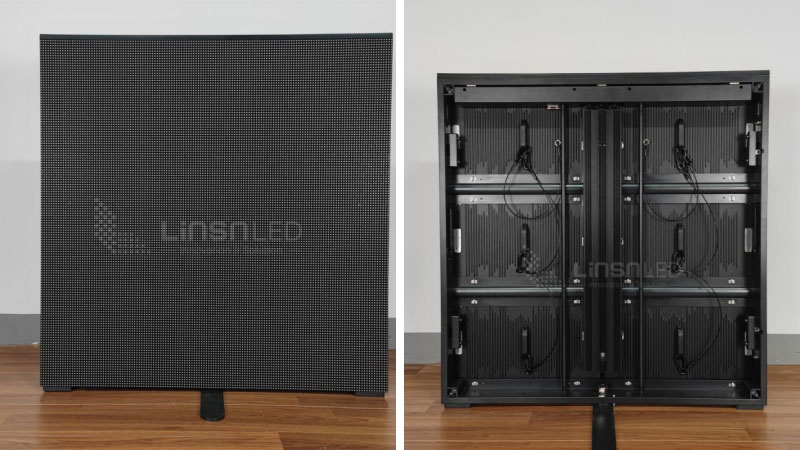
Built for stadium impact: Soft mask and rubber cushion protection on the front face, plus an IP65 or IP66 waterproof rating, so the screen holds up to both stray balls and outdoor weather.
Front and rear maintenance: Several models support both, so a damaged module gets swapped without tearing into the structure behind the screen.
Lower running cost: Models like the OF800-S and MA960-S cut energy use by 30% to 50% compared to older LED technology, at the same brightness.
Support beyond the sale: Every model carries a 3-year warranty, backed by a team that stays available for technical support after installation.
If you’re ready to move forward, you can contact LedInCloud for a full quote from our team.
8. Real Case Studies
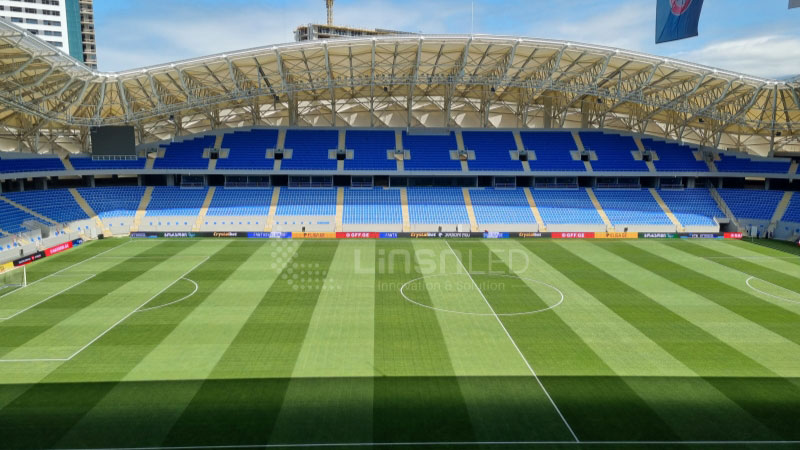
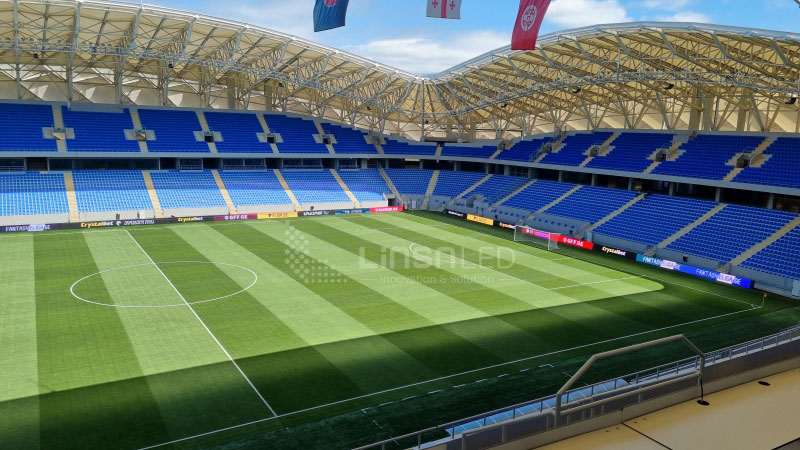
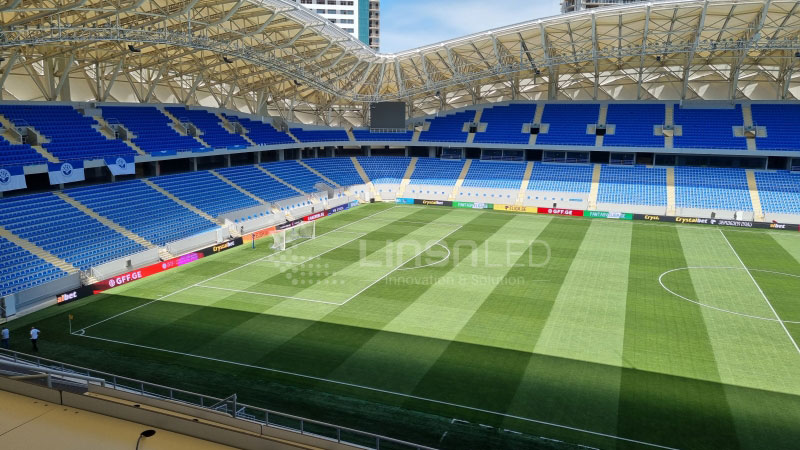
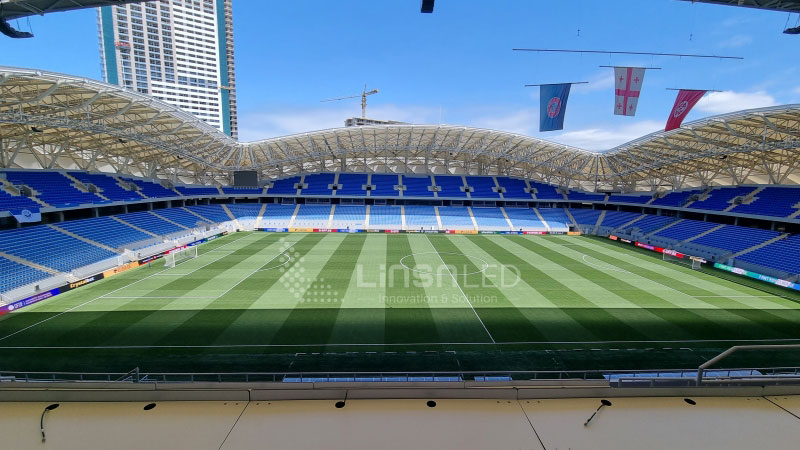
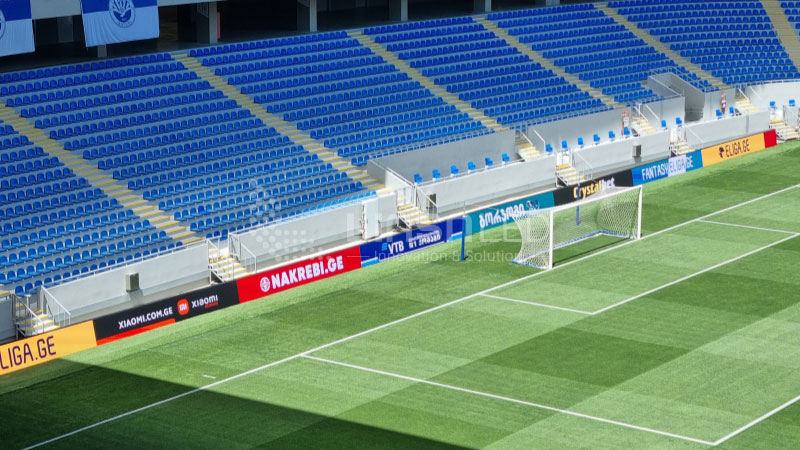
LedInCloud’s stadium screens run in venues across multiple countries. The Georgia installation is one example. You can see it directly.
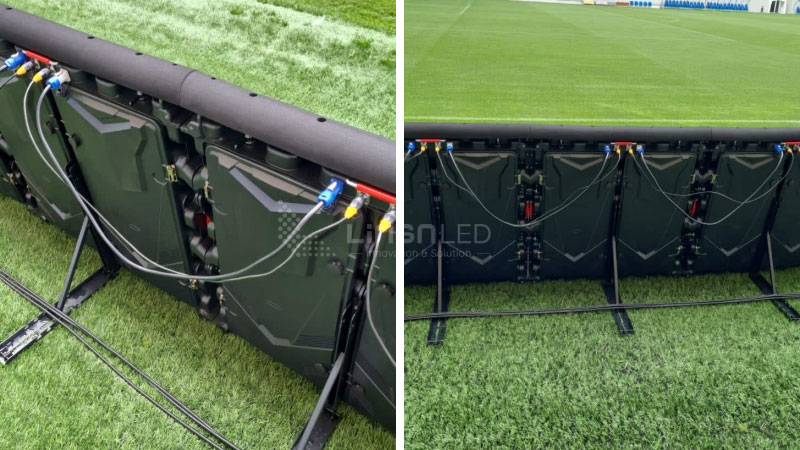
Outdoor perimeter LED display, Georgia. LedInCloud’s MA960 Series was installed as an outdoor perimeter LED display in a stadium in Georgia. It runs at a P10 pixel pitch, built for large-format outdoor viewing at distance. The installation sits along the pitch-side edge. Soft mask protection covers the front, standard for perimeter systems in active play areas. That’s because the screen sits within reach of the game itself.
You can see the installation footage and more customer cases on our customer cases studies page.
9. Conclusion
A stadium LED screen isn’t one product. It’s a system built from several types, each doing a different job. Perimeter displays take the hits. Center screens carry the replays. Ribbon boards sell the ad space.
LedInCloud builds across that full range, from P4 to P16, with the durability and support to back it. If you’re planning a stadium LED display, our team can help you land on the right spec, not just a screen that looks good in a spec sheet.